Capital Allocation: Skill Shows in Where the Money Earned Is Spent
Just as important as a company earning money well is spending the money it earns well. That decision — “where should the cash we generated go?” — is capital allocation. Take two companies earning the same profit: if one reinvests that money in high-return businesses or returns it to shareholders while the other wastes it on pointless acquisitions and undisciplined expansion, the fate of their shareholders diverges completely as time passes. Capital allocation is where management’s skill and philosophy are exposed most nakedly. This article walks through the five destinations for cash and the standards for good and bad allocation, using a real company (Muhak) as the case.
The five places cash can go
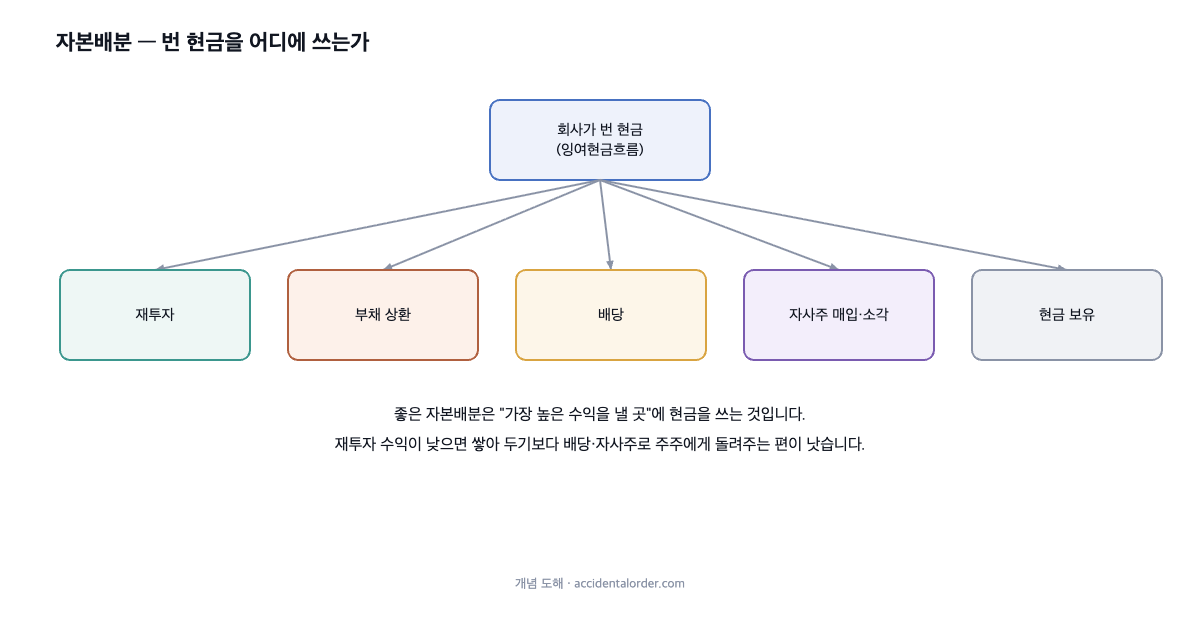
The free cash flow a company generates can broadly go to five places. First, reinvestment (capacity expansion, R&D, new businesses); second, debt repayment; third, dividends; fourth, share buybacks and cancellation; and fifth, holding it as cash. The first four spend the money; the fifth piles it up unspent. Good capital allocation means sending the cash to “whichever of these five creates the most value at that moment”.
The core test is a single one. If the company can reinvest the money and earn a return above its cost of capital (ROIC), reinvestment is best. If there is nowhere to do that, it is better to return the money to shareholders through dividends or buybacks than to force it into low-return businesses or let it sit. Shareholders can put that money to better use themselves. This simple principle is the compass of capital allocation.
Reinvestment — the most important and most difficult choice
The first and most important destination in capital allocation is reinvestment. Put the money earned back into a high-return business and that money earns a high return again, creating a virtuous compounding cycle. This is why “a company that sustains high profitability and still has ample room to reinvest”, as seen in the ROE and ROIC piece, grows its value explosively over the long run.
But reinvestment also carries big traps. When management is obsessed with growth and pushes money even into low-return areas, revenue and corporate size grow while shareholder value is actually destroyed. Reckless diversification into fields unrelated to the core business, large capacity expansion at a cyclical peak, and expensive acquisitions are the classic cases of failed capital allocation. The important thing is not to be intoxicated by the word “growth” and mistake bad reinvestment for good growth.
Dividends — the most direct return
A dividend is a company handing part of its profit directly to shareholders in cash. It is the most transparent and most direct form of shareholder return. A steadily rising dividend is read as a signal that the company is earning cash stably and respects its shareholders. That said, dividends have the characteristic that once started they are hard to reduce (a dividend cut is a strongly negative signal), so companies set them at a sustainable level.
The sustainability of a dividend is judged not against net profit but against free cash flow — the ratio of the dividend to it (the payout ratio). If free cash flow comfortably covers the dividend it is stable; if the dividend exceeds free cash flow, the company is paying it out of debt or by selling assets, which cannot last. Before being drawn in by a high dividend yield, check whether that dividend comes out of cash the company genuinely earned.
Treasury shares — buying back and cancelling are not the same
A buyback is a company purchasing its own shares in the market. The number of shares in circulation falls, which raises the value of the stake held by the remaining shareholders. But there is an important distinction here. If the repurchased shares are cancelled, the share count falls permanently and it becomes a definite shareholder return; if they are merely held without cancellation, they can later be sold back into the market or distributed to employees, and the benefit disappears. That is why “buy back, then cancel” is the genuinely strong signal of shareholder return.
Buybacks are especially effective when the share price is below intrinsic value. Buying shares cheaply and cancelling them is a large gain for the remaining shareholders. Conversely, buying back when the share price is expensive means paying up, and can actually destroy value. So for buybacks too, “when and at what price” matters, and this judgement likewise reveals management’s skill at capital allocation.
Net cash — the problem with hoarding
Holding cash rather than spending it is also a choice. An appropriate level of cash is a shield against crisis and the ammunition to seize a good opportunity when it comes. The problem is holding far more than necessary for far too long. When cash simply keeps building up with nowhere to reinvest and nothing returned to shareholders, that money earns only low deposit interest and drags down capital efficiency (ROE). From a shareholder’s point of view, such sleeping cash is an “asset that does not work”.
And this point leads straight into the story of Muhak.
Measured — Muhak’s capital allocation
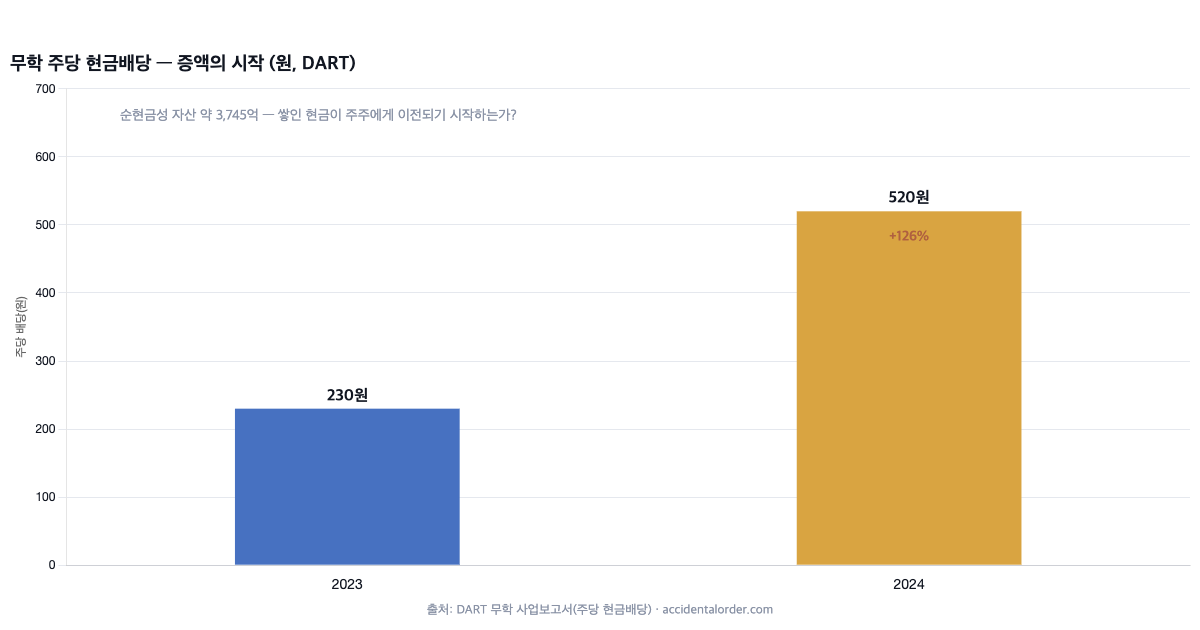
Muhak holds roughly KRW 374.5bn of net cash-equivalent assets, more than its market capitalisation (roughly KRW 214.9bn). As we saw in the earlier EV piece, the market values Muhak’s core business at a mere KRW 6.6bn, and behind that lies a long-standing question: “will this thick pile of cash ever flow out to shareholders?” If cash is only hoarded, the share price stays low however many assets the company holds.
Yet signs of change are visible. Muhak’s cash dividend per share rose 126%, from KRW 230 in 2023 to KRW 520 in 2024, and filings relating to treasury shares have appeared as well. If cash that had only accumulated begins to be transferred out through dividends and buybacks, that can be the catalyst that resolves a long-running undervaluation. This is the substance of the core thesis staked in our Muhak stock analysis — “does the growing net cash keep being transferred to shareholders through dividends and buybacks?” It is a case where capital allocation itself becomes the investment thesis.
Debt repayment — the capital allocation nobody notices
It is not as glamorous as dividends or buybacks, but debt repayment is important capital allocation too. Paying down debt reduces the interest burden, which raises future profits, and strengthens the balance sheet so the company can better withstand a crisis. Particularly where interest rates are high or debt is heavy, using the cash earned to repay borrowings can be a better choice than paying dividends or making a stretched investment.
Debt repayment shows up on the balance sheet as net borrowings falling steadily. On the surface it is unpopular, because unlike dividends and buybacks no money goes directly to shareholders, but it is a solid choice that lowers financial risk and protects shareholder value over the long term. Good management balances repayment against shareholder returns while watching the company’s financial condition and the interest-rate environment.
Payout ratio and dividend yield — two different numbers
There are two dividend measures that are often confused. The payout ratio is the share of net profit paid out as dividends (total dividends ÷ net profit), showing how much of the profit the company shares out. The dividend yield is dividend per share divided by the share price, showing what percentage you receive as dividends if you buy at today’s price. If the payout ratio is low while the dividend yield is high, it may mean the share price is that cheap.
You need to look at both together to get it right. Buying because the dividend yield alone is high risks finding that the dividend is overstretched (a high payout ratio) or that the share price has fallen because it reflects underlying weakness. Conversely, a company with a low payout ratio, plenty of room to raise the dividend further, and which has just begun raising it, is attractive. Muhak raising its payout ratio and lifting the dividend by 126% is a change that came out of exactly that room.
The Korea discount and capital allocation
One of the main causes cited for the so-called “Korea discount” — the Korean market being valued lower than others — is the culture of capital allocation and shareholder returns. Companies earning profits have been passive about dividends and buybacks, hoarding cash instead, and decisions have been made mainly in the interests of controlling shareholders, leaving minority shareholders’ interests as an afterthought. As a result, companies cheap relative to net assets (low PBR) have been left neglected for long stretches.
Recently there are signs that this culture is changing. Expanded shareholder returns, cancellation of treasury shares and governance improvements are drawing attention as catalysts that dissolve undervaluation. When we stake the core thesis for a stock like Muhak in our analysis ledger as “does the cash get transferred to shareholders?”, it is precisely to confirm over time whether this shift in capital allocation actually happens. Capital allocation is an issue for the individual company and at the same time is tied to the re-rating of the market as a whole.
The compounding effect of share cancellation
In a company that steadily buys back and cancels its own shares, the share count falls as time passes, so earnings per share (EPS) keeps rising even if profit stays flat. This is quiet compounding. Cancel 3% of the shares each year, for example, and after ten years the shares in circulation have fallen substantially, meaning you hold a far larger stake in the same company. It is less visible than a dividend, but over the long run it is a powerful shareholder return.
As stressed above, though, this effect only exists if it is “buy back, then cancel”. Piling up treasury shares without cancelling them means they can return to the market at any time, so it is not a return at all. When you look at filings about treasury shares, do not stop at “purchase” — check whether it carries through to “cancellation”. A genuinely shareholder-friendly company cancels the shares it has bought so the move cannot be reversed.
The signals of bad capital allocation
Conversely, there are signals of a company that allocates capital badly: diversifying recklessly into low-return areas even though the core business is good; acquiring companies at high prices at a cyclical peak; continuing to pile up cash even though reinvestment returns are low; buying back shares when the price is expensive; and eating into the balance sheet with a stretched dividend that exceeds free cash flow. Such decisions are packaged for the moment as “growth” or “shareholder return”, but with time they impair shareholder value.
M&A — the largest and riskiest capital allocation
The largest and hardest-to-reverse form of capital allocation is mergers and acquisitions (M&A). Acquiring a good company at a reasonable price can accelerate growth greatly, but statistically a considerable share of M&A is known to destroy value for the acquirer’s shareholders. The reasons are several: management pays too much out of an appetite for empire-building, overestimates synergies, or fails to integrate two different organisations.
So when a company announces a large acquisition, rather than welcoming it unconditionally you should ask “at what price did they buy?” and “can that business earn more than the cost of capital?” Expensive acquisitions made at a cyclical peak or in an overheated market are a particular warning sign. Conversely, a company that acquires good assets cheaply during a downturn when everyone else is frightened is likely to have management skilled at capital allocation. M&A is the stage where capital-allocation ability is tested with the largest sums.
Capital allocation and the company’s life cycle
Good capital allocation differs according to the company’s stage of life. An early-growth company has many places to reinvest, so putting most of the money earned back into the business is right. Straining to pay dividends at that stage eats into growth instead. A company that has entered maturity and whose reinvestment returns have fallen, by contrast, should return surplus cash to shareholders via dividends and buybacks. Insisting on low-return reinvestment after growth has stopped destroys value.
So you should ask “what stage is this company at now?” and judge whether the capital allocation fits that stage. A company like Muhak, with limited growth in its core business but thick cash holdings, is at a stage where shareholder returns suit it better than reinvestment. A growth company that still has places to reinvest at high ROIC and a mature company that should be giving cash back look different when their capital allocation is good. When a company’s stage and its capital allocation are out of alignment, that misalignment is itself a problem — and sometimes an opportunity for change.
Capital allocation is management’s report card
In the end, capital allocation is the area where management’s skill and sincerity are revealed most honestly. Track where the company spent the money it earned over many years and whether those decisions grew or destroyed shareholder value, and you will see whether that management can be trusted. More than a dazzling vision or an earnings presentation, the capital-allocation record of the past five to ten years tells you accurately what management is. That is why, in picking a good company, you ask “does this management spend the money it earns well?”
To add one practical perspective: capital allocation is the key that separates “growth in profit” from “growth in per-share value”. Even if total company profit rises, if the share count rises alongside it through rights issues, value measured per share may be flat or even lower. Conversely, even if profit does not grow much, cancelling shares reduces the share count and per-share value rises. What matters to an investor is not the company’s bulk but the value of each share they own, so you must always look at how capital allocation affects the share count.
So good capital allocation summarised in one sentence is this: “reinvest if reinvestment can earn more than the cost of capital, return the money to shareholders if it cannot, and make every one of those decisions fairly for all shareholders.” It looks simple, but few companies hold to this principle for long, and for those that do, time proves their worth. Understand capital allocation and you gain one more eye for picking out the genuinely good company beyond good reported results.
Governance and the direction of capital allocation
Whose interests capital allocation serves is deeply entangled with governance. In a company where the controlling shareholder’s stake is large and the voice of minority shareholders is weak, capital allocation can drift in the direction that favours the controlling shareholder — for example, steering work to affiliates in which the controlling shareholder holds a stake, or decisions made to facilitate succession. In that case, however well the company earns, the fruits are not distributed fairly to minority shareholders.
So when you look at capital allocation you have to ask “is this decision for all shareholders, or for particular shareholders?” Related-party transactions, acquisitions with scope for conflicts of interest, merger ratios unfavourable to minority shareholders — these are risk signals to be checked in the notes and the filings. Good capital allocation is not merely “spending money well” but “spending it fairly for every shareholder”. This question of fairness also connects to the related-party transactions in the audit report and notes, which the next article covers.
Ultimately capital allocation, shareholder returns and governance are bound together as one. Where the money earned is spent, whose benefit it serves, and whether that process is transparent all combine to determine the quality of the company. However good the numbers in the financial statements, if these three are out of alignment those good results do not come back to shareholders in full. That is why seasoned investors spend as much time on “how, and for whom, does this company spend the money it earns?” as on the results themselves.
Frequently asked questions (FAQ)
Q1. Which is better, dividends or buybacks?
It depends on the situation. When the share price is below intrinsic value, buying back and cancelling shares is more advantageous to the remaining shareholders; when the share price is expensive, dividends are better. Also, a dividend gives you cash directly but attracts tax, while a buyback works by raising per-share value. The key points are whether the treasury shares are “cancelled” and whether the dividend is “sustainable”.
Q2. Is a company with lots of cash always good?
No. An appropriate cash buffer is a safety net, but excess cash with nowhere to go and no return to shareholders is a “sleeping asset” that drags down capital efficiency. Even for a cash-rich company like Muhak, the question is whether the structure lets that cash flow out to shareholders.
Q3. Isn’t investment for growth always a good thing?
Not so. It is only a good investment when the return on reinvestment (ROIC) is higher than the cost of capital. Pushing money into low-return areas in the name of growth swells revenue while destroying shareholder value. “Growth” and “value creation” are not the same thing.
Checklist for looking at capital allocation
- The past five to ten years: where was the money spent, and what came of it?
- Return on reinvestment: was it invested where ROIC exceeds the cost of capital?
- Shareholder returns: the dividend trend, and whether treasury shares were “cancelled”.
- Excess cash: is it merely piling up with nowhere to go?
- Bad signals: peak-cycle acquisitions, reckless diversification, an overstretched dividend?
Summary
Capital allocation is the decision of which of the five destinations — reinvestment, debt repayment, dividends, buybacks or holding cash — receives the cash a company earns. The test is “wherever it creates the most value”, and where the return on reinvestment is low, returning the money to shareholders is the better course. Whether accumulated cash begins to be transferred out through dividends and buybacks, as at Muhak, is the catalyst for resolving undervaluation. Capital allocation is the report card on which management’s ability is revealed, so it must be checked when choosing a good company. The next article covers the audit report and the notes that underpin the reliability of all these numbers, and how to read risk from them.
Investing study · fundamental analysis. This article is for information only and is not a recommendation to buy or sell any particular security. Figures follow the original DART filings and may have changed since the time of writing (July 2026).