Audit Reports and the Notes: Can You Trust the Numbers, and What to Watch For
So far we have learned to read the numbers in the income statement, the balance sheet and the cash flow statement, and to weigh profitability and value with them. Yet all of this rests on a single premise — that those numbers can be trusted. What holds that trust up are the audit report and the notes. The audit report is the result of an independent outside accounting firm verifying the financial statements; the notes are the footnotes explaining how each individual number came to be. The more seasoned the investor, the faster they skim the big headline figures in the main statements and the longer they linger on the audit opinion and the notes. This article covers how to read an audit opinion, and how to find risk in the notes.
The audit report — verification from outside
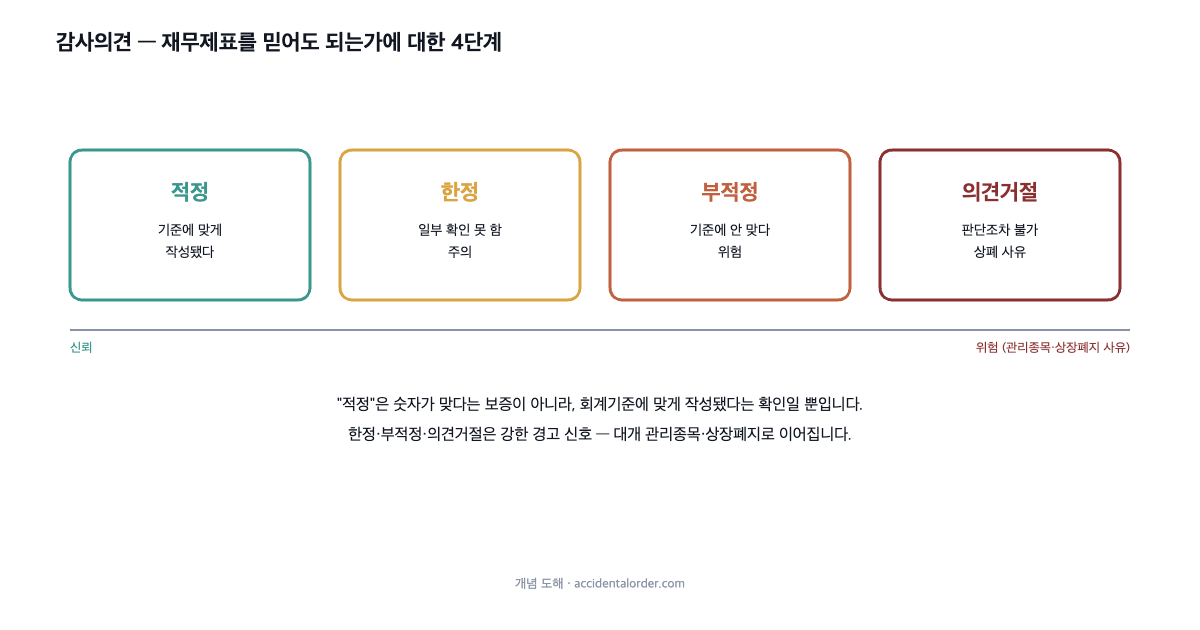
In principle a listed company prepares its own financial statements, but an independent outside accounting firm (the auditor) separately verifies the result and issues an audit report. The company writes its own record and a third party checks it. Because that check exists, we can place some degree of trust in the numbers of a company we have never met. The heart of the audit report is the audit opinion at the very front, and it comes in four kinds.
An unqualified opinion means the financial statements were prepared in accordance with accounting standards, and most companies in normal condition receive it. A qualified opinion is a warning that some items could not be verified or depart from the standards. An adverse opinion is a strong negative — the statements do not conform to the standards and cannot be relied on — and a disclaimer of opinion means the material was so deficient or so uncertain that the auditor could not even form a judgement. The risk grows as you move down the list.
What “unqualified” really means — it is not a guarantee of the numbers
Here we have to address the most common misunderstanding. An unqualified opinion is not a warranty that “this company’s finances are sound” or that “the numbers are accurate”. It is only confirmation that the statements “were prepared in accordance with accounting standards”. A loss-making, financially weak company will still receive an unqualified opinion if it recorded that weakness honestly and by the book. So an unqualified opinion is the minimum condition for looking at a company’s numbers at all, not a stamp that says “good company”.
Conversely, a qualified, adverse or disclaimed opinion is a very strong warning. It means the accounting numbers themselves cannot be trusted, so however elaborate a valuation you build on top of them, you are building a castle on sand and the exercise is meaningless. And in Korea a non-clean opinion usually leads to designation as an administrative issue (gwanri jongmok, a watchlist status the exchange assigns to companies with financial or disclosure problems) or becomes a ground for delisting. That is why, whatever the stock, checking the audit opinion is the most basic safety check and the first one to perform.
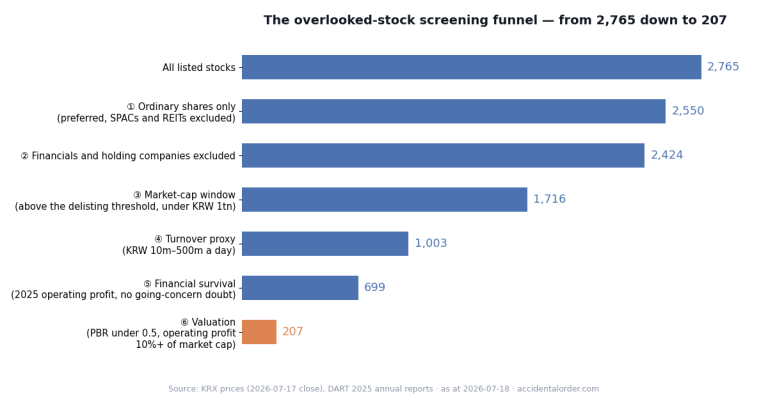
This point connects directly to our screening. In the screener that filters for overlooked stocks, the reason we excluded administrative issues (stocks designated for distress reasons, including a non-clean audit opinion) first is exactly this. However cheap it may look, a company with a non-clean audit opinion or on the administrative-issue list never reaches the starting line of our analysis, because the financial numbers themselves cannot be trusted. The audit opinion is the first gate that decides whether a company is even worth analysing.
The limits of the auditor — even verification has gaps
An audit does not filter out every irregularity. The auditor tests samples and forms a judgement on the basis of material provided by management, so if a company sets out to deceive, the audit can miss it. Historically, a considerable number of large accounting-fraud cases blew up while the company held an unqualified opinion. Believing that “it received an unqualified opinion, so it is perfectly safe” is therefore dangerous.
There is also a structural limitation that is often pointed out: because the auditor is paid its fee by the company, its independence may not be perfect. Institutions such as periodic auditor rotation and stronger audit committees exist to compensate for these limits, but from an investor’s standpoint the safer attitude is that “the audit is not the last line of defence, only one of several safeguards”. In the end you have to train your own eye to compare cash flow against the notes and look for abnormal signals.
Key audit matters — where the auditor struggled most
Recent audit reports include a section called key audit matters (KAM). In it the auditor discloses the areas it considered most important and most difficult to judge while auditing that company. Examples are “the appropriateness of revenue recognition”, “the assessment of goodwill impairment” or “the fair value measurement of a particular asset”. In practice this section amounts to the auditor pointing out “this is the riskiest or most judgement-sensitive spot in this company”.
Key audit matters are therefore an excellent risk map for investors. Since a professional tells you where they laboured hardest, you can go and look at those same items in the notes in more detail. When you open an audit report, do not check the opinion and close it — read on to see what the key audit matters are, and you will get a feel for where the company’s soft spot lies.
Corrections and restatements of financial statements
From time to time a company later revises financial statements it disclosed in the past. Some are simple corrections of error, but a restatement that is large in scale or spans several years is itself a warning signal. It means past results were not what they appeared, and the judgements built on them start to wobble. The correction-filing history on DART (Korea’s mandatory electronic disclosure system) will show you whether such a restatement occurred.
When this site finds an incorrect figure in an analysis piece, it fixes it immediately and leaves the correction history as a footnote — and that comes from the same spirit. Numbers can be wrong, and quietly fixing a mistake is not the same as correcting it transparently with a record. When you look at a company’s correction filings too, checking “what was wrong, why, and how it was fixed” lets you gauge how much confidence its accounting deserves.
The notes — the map behind the numbers
If the audit opinion is the gate marked “can this be trusted”, the notes are the map marked “what should you be careful about”. The face of the financial statements shows only summarised numbers; the assumptions and policies that produced those numbers, and the risks that never surface in the main statements, are all in the notes. Not reading the notes is like reading only the body of a contract and skipping the fine print.
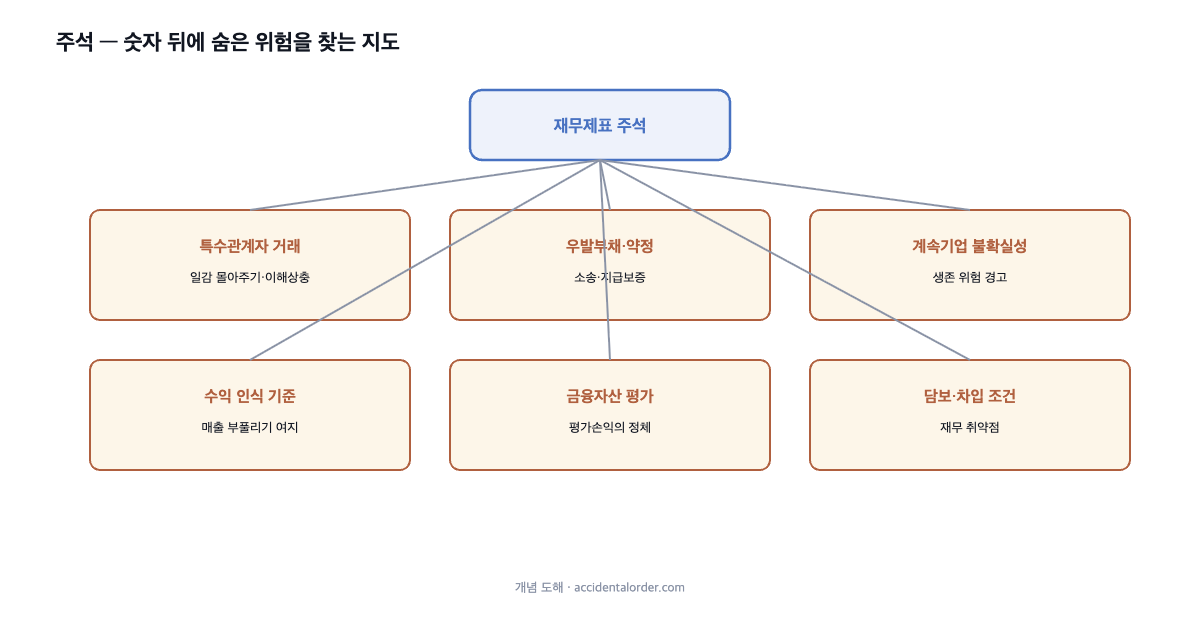
What you must check in the notes
Related-party transactions: what kind of business the company does with its controlling shareholder or affiliates, and how much of it. Conflicts of interest such as steering work to affiliates or transactions on unfairly favourable terms show up here. It is the key item for seeing whether capital allocation is fair to minority shareholders. Contingent liabilities and commitments: risks such as ongoing litigation or payment guarantees that are not yet fixed and so do not appear in the main statements, but that would become large losses if they materialised.
Revenue recognition policy: when and how revenue is booked, which is where the room for inflating revenue becomes visible. Valuation of financial assets: for a company like Muhak with large holdings of financial assets, the true nature of those valuation gains and losses sits in the notes. It is the same as when we went looking for why net profit swings earlier and ended up in the notes. Beyond these, assets pledged as collateral, borrowing covenants, depreciation methods — every assumption that moves the numbers is contained in the notes.
Going-concern uncertainty — the most frightening sentence
The heaviest warning in the notes and the audit report is a reference to going-concern uncertainty. This is the auditor formally stating that “there is substantial doubt about whether this company can continue to operate normally”. Funding difficulties, large-scale losses or an inability to service debt are the usual reasons. When this phrasing appears, it is a strong signal that the company’s very survival is at stake, no matter how many assets it appears to hold.
So when you look at an unfamiliar stock, especially one whose finances look fragile, you should first check whether the audit report contains anything about going concern. Miss that one sentence and you can make the fatal mistake of buying a company that may soon be delisted because it looks “cheap”. The notes are an early-warning device that tells you about this worst-case risk in advance.
The smell of accounting fraud, and the notes
In the earlier piece on the cash flow statement, we identified “profits appear but operating cash flow does not follow” as the smell of accounting fraud. The place to confirm the source of that smell is precisely the notes. If trade receivables have grown abnormally, the breakdown is there; if inventory has piled up, its valuation is there; if profit has been inflated, the accounting policy behind it is there. Comparing the anomalies on the face of the statements against the explanations in the notes is the practical method for detecting fraud early.
Of course it is hard for an individual investor to catch a sophisticated fraud perfectly. But simply becoming strongly suspicious and staying away when signals overlap — a gap between profit and cash, a jump in trade receivables, large transactions with related parties, frequent correction filings, a change in the audit opinion — is enough to avert a serious accident. Rather than trying to verify everything perfectly, filtering out companies where warning signals overlap is the realistic defence.
The limits of automation — why a person is needed behind the screener
Our screener excludes administrative issues and filters candidates on financial criteria, but it cannot automatically read the detail of an audit opinion or the subtle risks in the notes. Whether a related-party transaction is improper, how serious a contingent liability is, what a key audit matter implies — in the end a person has to read the notes and judge. So the screener only hands over a “shortlist worth reading”, and the next step is a person opening the annual report.
This is the division of labour between data and judgement. The machine quickly narrows a vast universe down to candidates that meet the criteria; the person reads those candidates’ notes and business descriptions and judges the risks and opportunities the machine cannot see. The audit report and the notes are the core of that part “the machine cannot fully read, so a person must”. Even a stock that has passed the numerical filters must be dropped if a fatal defect turns up in the notes.
Be humble about the numbers, be thorough with the notes
There is an attitude we have repeated all the way through the fundamentals track: the numbers in financial statements are not “absolute truth” but “the best-organised estimate, with assumptions mixed in”. And where are those assumptions written down? In the notes. So treating numbers with humility shows up in practice as the habit of reading the notes carefully. The difference between an investor who reads only the headline figures and one who reads the notes as well is what separates those who can avoid risk in advance from those who cannot.
The notes are not only for finding risk
The notes are a risk map, but they are also a place to discover good signals. If related-party transactions are almost absent and transparent, that is a signal of sound governance; if contingent liabilities are negligible, hidden risk is small. Share buyback and cancellation plans, dividend policy, stable revenue recognition policies — when these are confirmed in the notes and the filings, they become grounds for rating the quality of the company highly.
Segment information by business line and by region also sits in the notes, showing the substance of where the company actually earns its money. This is where you confirm things like Cuckoo Homesys’s share of overseas revenue, or the business mix of a given company. So reading the notes is not merely an exercise in getting scared; it is the process of grasping the company’s true shape in three dimensions, something the headline numbers alone cannot show. Reading risk and opportunity together is the right way to use the notes.
Audit and notes checklist
- Audit opinion: is it unqualified? Qualified, adverse or disclaimed calls for immediate caution.
- Going-concern uncertainty: is there any reference to the company’s survival?
- Key audit matters (KAM): where is the soft spot the auditor laboured over most?
- Related-party transactions and contingent liabilities: conflicts of interest, litigation, payment-guarantee risk.
- Correction-filing history: has the company ever substantially revised past financial statements?
A company is both numbers and a story
As we close the fundamentals track there is one thing worth stressing. A company is a collection of numbers and at the same time a story. The numbers in the financial statements quantify that story, and the audit opinion and the notes tell you how trustworthy those numbers are and what risks they carry. Good analysis reads the numbers and the story together — what the company earns its money from, whether that profit is real, how long it can last, and for whose benefit the money earned is spent.
The tools learned across these ten pieces — the three financial statements, consolidated versus separate, ROE and ROIC, PER, PBR, EV and DCF, capital allocation, audit and notes — are not disconnected pieces of knowledge but link into a single lens. Look at a company through that lens and you can judge for yourself whether “this really is a good business, and whether the price is cheap right now”, instead of being swept along by dramatic news or a surging share price. Committing the result of that judgement as a core scenario and revisiting it each quarter in stock tracking is what this site means by “investing that is updated every quarter”.
Open an audit report for the first time and the legal language makes it feel difficult, but in practice the places you need to look are fixed. The audit opinion paragraph at the very front (unqualified or not), the emphasis-of-matter paragraphs or going-concern references just below it, and the key audit matters. Check those three places alone and you have most of the answer to “can I trust this company’s numbers enough to analyse it”. For the rest of the detail, follow the relevant note whenever an anomaly appears.
And this habit matters even more when you look at little-known stocks such as overlooked small caps. Large caps are watched by many people, but the further a small company sits outside the market’s attention, the more likely it is that hidden risk has been left unattended. When cheapness draws you towards an overlooked stock, checking the audit opinion and the notes first is the decisive gate between the trap of “cheap for a reason” and a genuinely overlooked quality company. It is the same reason our screener strips out administrative issues first.
Pay particular attention to changes in the audit opinion
To highlight one practical signal: “changes” in the audit opinion deserve especially close attention. When a company that has received unqualified opinions for years suddenly receives a qualified one, when the auditor changes frequently, or when a new limitation on audit scope is mentioned, that is a strong warning. It may be an early signal that something is going wrong inside the company. Conversely, a track record of continuous unqualified opinions supports the stability of its accounting.
So when looking at a stock you should consider not just this year’s opinion but the trend over the past several years. The timing of an auditor change and the reason for it, newly added emphasis-of-matter paragraphs in the audit report — these are the clues to a change. Catch such signals early and you can avoid the risk before the problem surfaces and the share price drops sharply. An audit report looks dry and tedious, but inside it sits an early warning about the company’s health.
To sum up, the audit report and the notes are the last and perhaps the most important safeguard in fundamental analysis: they verify the reliability of the financial statements and expose the risks behind them. The single habit of checking these two things before diving in after impressive numbers is what separates the investor who avoids fatal losses and survives for a long time from the one who does not. Avoiding bad companies protects long-run returns just as much as finding good ones.
Frequently asked questions (FAQ)
Q1. If the opinion is unqualified, can I relax?
No. An unqualified opinion is only the minimum condition — that the statements “were prepared in accordance with accounting standards” — not a statement that the company is sound. A loss-making, financially weak company will receive an unqualified opinion if it records that weakness honestly. The audit opinion is the beginning of the safety check, not the end.
Q2. The notes are enormous — do I have to read all of them?
You do not need to read every word, but you should look at the key items. Check related-party transactions, contingent liabilities and litigation, any going-concern reference, and whatever is particularly important for that company (for example, the valuation of financial assets at a company with large financial-asset holdings). If a number on the face of the statements struck you as odd, follow its note number.
Q3. Where do I find the audit opinion?
At the very front of the annual report and the audit report on DART. Search by company name, open the periodic filing, and the audit report is attached with the audit opinion at its head. The history of administrative-issue designation and delisting can also be checked on DART and in exchange filings.
Summary — closing the fundamentals track
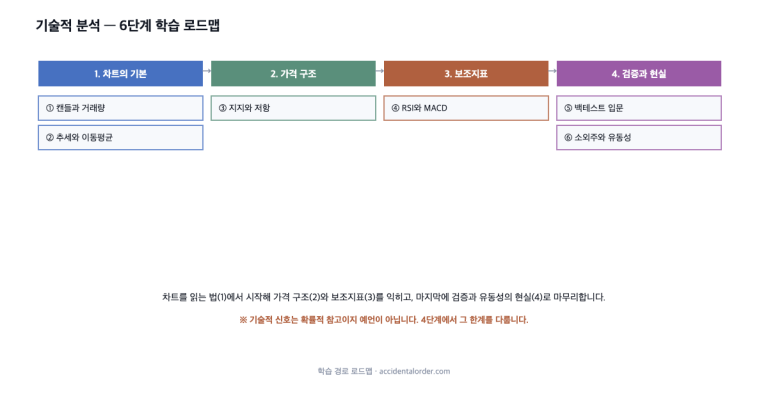
The audit report is the gate that decides whether the financial statements can be trusted, and the notes are the map for finding the risk behind the numbers. An unqualified opinion is not a guarantee of quality but only a minimum condition, while a non-clean opinion is a strong warning that leads on to administrative-issue designation and delisting. Items such as related-party transactions, contingent liabilities and going-concern uncertainty do not appear on the face of the statements and exist only in the notes, so failing to read them means missing large risks. With this we have completed one full circuit of fundamental analysis: reading the financial statements, weighing profitability and value, and then checking their reliability. If the tools built up over these ten pieces are the skeleton of “what to buy”, the technical analysis track deals with executing that judgement and reading charts on an evidence base.
Investing study · fundamental analysis. This article is for information only and is not a recommendation to buy or sell any particular security. Figures follow the original DART filings and may have changed since the time of writing (July 2026).