What Is an ETF: From the Concept to the Costs
If the earlier articles put up the skeleton of an account — asset allocation and diversification — you now need the instruments that fill each of its compartments. Today the standard instrument for that job is the ETF: a vessel that lets you hold an entire market, or bonds, or gold, or one particular industry, as easily as buying a single share. But vessels have quality too. What to look at when several ETFs track the same index, and which costs are invisible from the outside, are the subjects of this article.
The order is structure → types → the three layers of cost → tax → how to choose → products to be careful with. The concepts are universal, but rules such as tax rates and contribution limits change frequently, so let us begin on the understanding that you check the regulations in force at the moment you act.
1. Structure: a vessel that holds an index
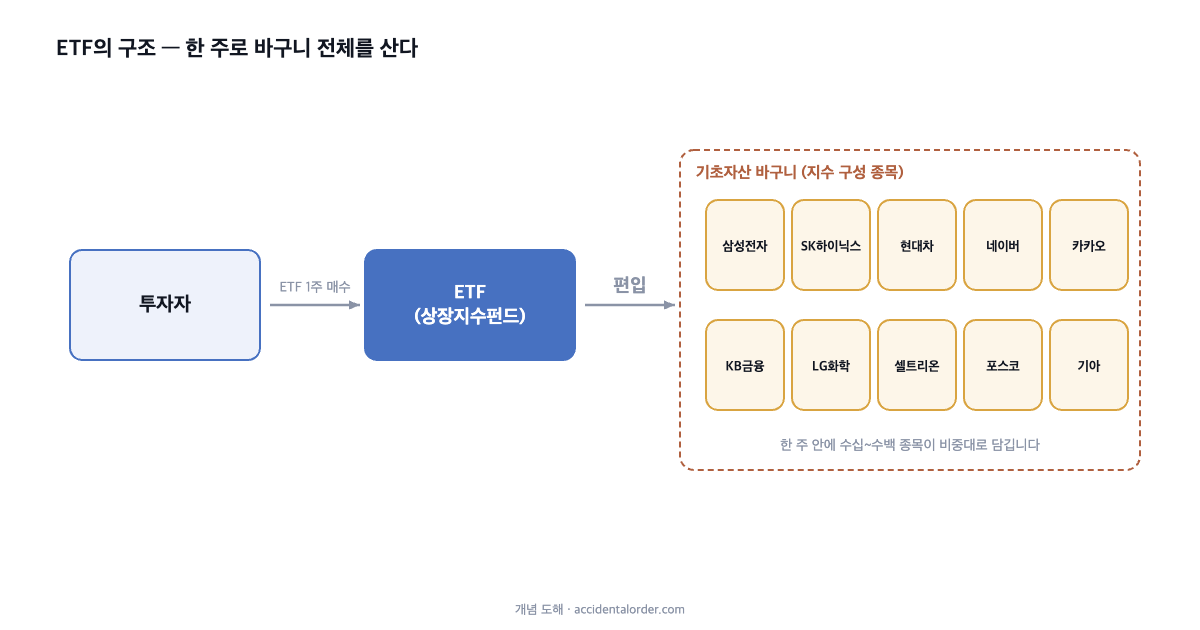
An ETF (exchange-traded fund) is a fund designed to follow a particular index, listed on an exchange. Buy one share of a KOSPI 200 ETF (the index of Korea’s 200 largest main-board companies) and you are buying a slice of the whole bundle of KOSPI 200 constituents; if the index rises 1%, the ETF is designed to rise 1% too. Unlike an ordinary fund it trades in real time during the session, and its holdings are disclosed daily, so its contents are transparent. The core mechanism of the structure is that when the market price drifts away from the underlying asset value (NAV), designated participants (LPs and APs) arbitrage the gap and pull the price back.
2. Types: a shelf holding virtually every asset
| Type | Example index / underlying | Purpose |
|---|---|---|
| Broad market index | KOSPI 200, S&P500, Nasdaq 100 | The core of a portfolio |
| Bond | Korean treasury bonds, US Treasuries, corporate bonds | Cushion, interest income |
| Commodity | Gold, crude oil | Inflation and crisis hedge |
| Sector and theme | Semiconductors, secondary batteries, AI | Satellite (add-on) positions |
| Dividend and income | High-dividend stocks, covered calls | Cash flow |
| Leveraged and inverse | ±2x the index’s daily return, etc. | Short-term tactics (unsuitable for the long term) |
The principle is simple — make the core broad and cheap with market index products, and hold only themes you have real conviction in as small satellite positions. The more dazzling the shelf, the easier it is for that principle to wobble.
3. Cost: all three layers have to be examined
Layer 1: the total expense ratio
This is what the manager takes each year, and because it is baked into the price you never feel it. Broad index products have come down into the 0.0X% range a year, while theme products at 0.4–0.5% are common. As we saw in the piece on compounding, a fee difference of 1 percentage point a year decides 20% of the final amount thirty years out. For the same index, the cheaper option is the default.
Layer 2: trading costs and the bid-ask spread
Beyond the broker’s commission, the gap between the buying price and the selling price — the spread — is a cost too. In an ETF that trades thinly the spread is wide, so you start out at a loss the moment you buy. The practical technique is to pick ETFs with large turnover and to avoid trading right after the open and just before the close, the times when prices are unstable.
Layer 3: premium/discount and tracking error
The premium or discount is how far the market price has drifted from NAV; tracking error is how far the ETF’s performance has drifted from the index’s. The first tells you “am I buying at a fair price right now”, the second “is this vessel doing its job”. Both are disclosed on manager pages and in exchange data, and both tend to stay small in ETFs with large net assets and active trading.
4. Tax: what you hold in which account
Even for the same underlying exposure, the after-tax outcome differs by product form and by account. Let us capture just the broad picture in a table (the detailed rates and limits are subject to change — checking before you act is essential).
| Category | Tax on trading gains (in an ordinary account) | Notes |
|---|---|---|
| Korean equity ETFs | Not taxed | Distributions taxed as dividend income |
| Korea-listed ETFs on foreign indices, bonds and commodities | Dividend income tax of 15.4% | Counts towards aggregate financial-income taxation |
| Foreign-listed ETFs (US and elsewhere) | Capital gains tax of 22% (KRW 2.5m annual deduction) | Separate from aggregate taxation |
| Inside a pension savings account, IRP or ISA | Tax deferral or low-rate separate taxation | The default vessel for long-term investing |
There are two takeaways. First, fill the tax-advantaged accounts first — deferral lets the engine of compounding run at full power. Second, the larger your financial income, the more the comparison matters between “aggregate taxation on a Korea-listed foreign ETF versus separate taxation on a foreign-listed one”. This choice is a textbook example of something that depends on individual circumstances.
5. How to choose: a five-minute checklist
Among candidates holding the same index, narrow the field in this order. (1) Net assets and time since listing (an ETF that is too small and too young carries delisting risk). (2) The total expense ratio. (3) Tracking error. (4) Turnover and spread. (5) Distribution policy (reinvesting or paying out). And finally, open up the actual holdings — with theme products in particular the name and the contents often diverge, to the point where an “AI ETF” has been known to have a telecoms carrier as its largest holding.
6. Products to be careful with
Leveraged and inverse products track a multiple of the “daily return”, so their value melts away in a sideways market. While the index goes 100 → 90 → 99, a return of -1%, a 2x leveraged product goes 100 → 80 → 96, or -4%: that compounding decay is built into the structure. Covered-call products look generous on distributions, but you should use them knowing that the cash flow was manufactured by selling away the upside in a rising market; synthetic ETFs should be used knowing they carry counterparty risk. The common principle: do not buy a product whose structure you cannot explain in one sentence.
7. A walkthrough: actually comparing three ETFs on the same index
Let us put the principle into practice. Suppose there are three ETFs tracking the same headline US index (the figures are an illustration, to show the method of comparison).
| Item | A | B | C |
|---|---|---|---|
| Net assets | KRW 4tn | KRW 800bn | KRW 35bn |
| Time since listing | 7 years | 3 years | 8 months |
| Total expense ratio (a year) | 0.07% | 0.15% | 0.05% |
| Tracking error, last 12 months | 0.12%p | 0.25%p | 0.60%p |
| Average daily turnover | KRW 30bn | KRW 4bn | KRW 300m |
| Distributions | Paid four times a year | Paid out | Reinvested (TR) |
C has the lowest fee but is full of traps — its net assets are small enough to carry delisting risk, its tracking error is eating up the entire fee saving, and its turnover is thin enough to hide a spread cost. It is a structure in which you save 0.02%p on the surface and lose 0.5%p underneath. As between A and B, if the purpose is long-term regular saving then A, which leads on scale, tracking error and liquidity alike, is the straightforward choice, and the only reason to pick B is if you need a characteristic A lacks (a currency-hedged version, or a TR version, say). Remember the order of comparison — scale and age → tracking error → total expense ratio → liquidity — and any combination can be settled inside five minutes.
8. Distributions and TR: where the compounding switch sits
The dividends paid by the stocks an ETF holds are handled in one of two ways. Distributing versions pay cash out at regular intervals; TR (total return) versions reinvest the dividends automatically inside the index. As we saw in the piece on compounding, reinvestment is the switch that turns compounding on, so for a long-term regular saver the TR version is structurally advantageous — nobody has to remember to reinvest the distribution, and taxation at the point of distribution is deferred as well (the tax treatment differs by product and by account, so this must be checked). Conversely, if the purpose is cash flow for living expenses, the distributing version is the right tool for the job. It is a question of purpose rather than of right and wrong, and since distributing and TR versions of the same index are often listed side by side, you usually have the choice.
9. Delisting: what to fear and what not to
ETFs get delisted too. When net assets sit at or below a given threshold (trust principal below KRW 5bn, for instance) for a prolonged period, the manager decides to wind the fund up — and here is the important fact: unlike the delisting of a share, the liquidation of an ETF is not an event in which your principal disappears. It is a procedure in which the holdings are sold and returned to investors at net asset value. The actual losses come from two places: selling in a hurry at market price once the liquidation notice has thinned out the order book, and the tax and repurchase costs that follow from an involuntary sale. The response is simple — choose ETFs with ample net assets in the first place (the first gate), and if a liquidation notice arrives, do not panic; either sell according to the published schedule or wait for the terminal distribution.
Frequently asked questions
Q. Why not raise returns with active or theme ETFs that beat the index?
There is no reason to forbid it, but start out knowing the data. In long-run performance comparisons (SPIVA and others), the majority of active funds failed to beat the index over periods of ten years or more, and theme ETFs show a repeatedly reported pattern of weak post-listing performance, because they tend to be listed when the theme is at its hottest. Hence the principle: index at the core, only themes you have conviction in as small satellites — a structure that confines the domain of entertainment and learning to a minority stake in the account.
Q. Same S&P500 — should I buy the Korea-listed or the US-listed version?
It is a trade-off between tax and convenience. The strength of the Korea-listed version is that you trade it in won during Korean hours and can hold it in a pension account; the US-listed version’s 22% capital gains tax under separate taxation (with a KRW 2.5m annual deduction) can favour those with large financial income. The usual order is to fill the pension and ISA allowances with Korea-listed products first, then choose for the remaining money according to your own tax situation. Tax rules change, so checking before you act is essential.
Q. Currency-hedged (H) or unhedged?
As we saw in the piece on diversification, dollar exposure has a history of acting as a cushion for a won-based investor in a crisis. Many therefore treat unhedged as the default for long-held equity products. For low-volatility assets such as bonds, on the other hand, currency movements can overwhelm the volatility of the asset itself, so the hedged version often suits the purpose better. It is a question that gets a different answer depending on the nature of the asset.
In closing
The ETF is the fairest instrument the individual investor has ever been given. It lets you buy the same market institutions buy, at the same level of cost. That the instrument is fair, however, does not mean every product is good — four principles, a broad and cheap core, small satellites, checking all three layers of cost, and tax-advantaged accounts first, are enough to keep you steady in front of a dazzling shelf.
That completes the instruments part of the series. In the applications part, what follows is the piece on overlooked stocks, on the corners the market’s spotlight never reaches, and the piece on short-selling data, on reading the data that points the other way. If it is the skeleton you want, go back to the pieces on asset allocation and diversification. Questions go to the contact address on the About page.
This article is intended as general information and does not recommend the purchase or sale of any particular product. Investment decisions and the responsibility for them rest with the investor.