Monami (005360): A National Brand Caught Between the Delisting Threshold and Solidarity Buying
This is a stock analysis that takes listed companies apart one at a time. It is not a recommendation to buy or sell any particular stock, and all figures are as of the time of writing (July 2026) and may change thereafter.
Core scenario: what is moving Monami’s share price right now is not earnings but the market-capitalisation threshold for delisting and a wave of “solidarity buying” by retail investors. The market capitalisation recovered by that solidarity buying will be tested again once the structural losses continue and the 2027 threshold (KRW 50bn) comes round. The questions that matter are (1) whether the market capitalisation can hold above the threshold line under its own power, and (2) whether operating profit turns positive. This reasoning is updated every quarter in stock tracking.
Why it is in the news now
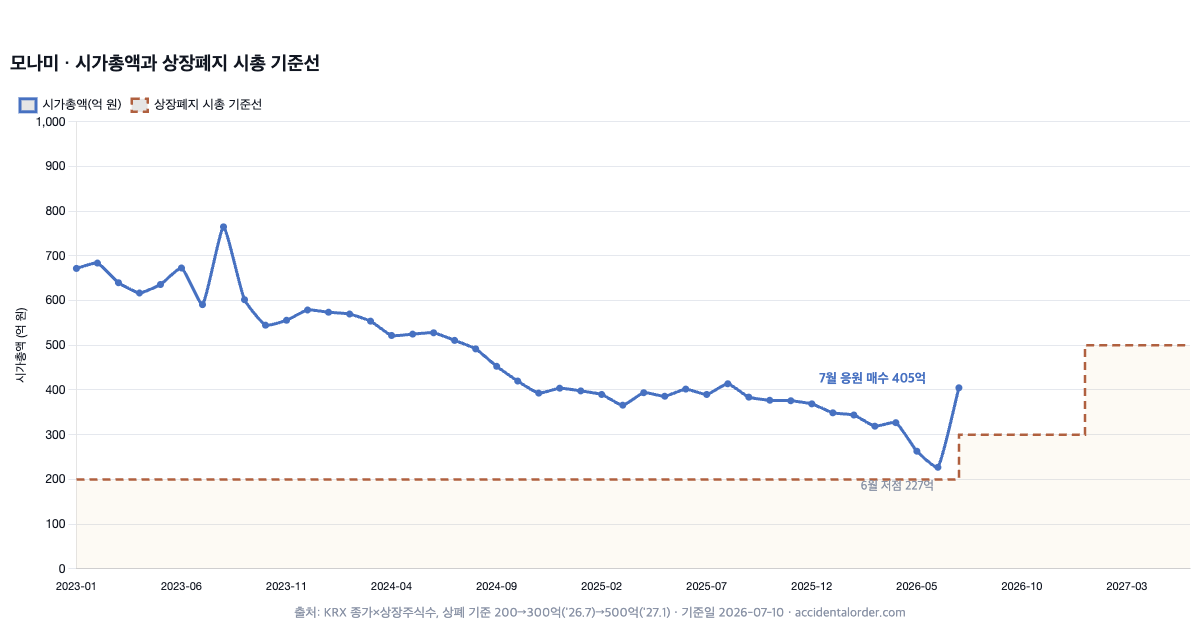
In July 2026, Monami drew the market’s attention not because of its earnings but because of an “event”. From this month the KOSPI’s market-capitalisation threshold for delisting rose from KRW 20bn to KRW 30bn, and in early July Monami’s market capitalisation sank to somewhere between KRW 24.8bn and KRW 25.9bn — below the threshold, that is, into the delisting-risk zone. At that point, with no particular good news from management, minority shareholders banded together online. A sentiment along the lines of “we cannot let Monami, a national brand, go under” spread, so-called “solidarity buying” (eungwon maesu, retail buying motivated by affection for a brand rather than by fundamentals) poured in, and on 10 July the share price jumped 25.66% in a single day to KRW 2,145, lifting market capitalisation to roughly KRW 40.5bn and clearing the threshold line — putting the immediate crisis behind it.
The episode is good material for analysis, because the company’s fundamentals did not change overnight while the share price rose 25%. In other words, this stock currently carries a price that earnings do not explain, and an investor has to ask what that premium is leaning on and when it will be put to the test.
Company snapshot
| Stock | Monami (KOSPI 005360) |
| Business mix | Writing instruments and stationery (Monami, Evergreen) + computer consumables + distribution |
| Share price / market capitalisation | Approx. KRW 2,145 / approx. KRW 40.5bn (2026-07-10, after the solidarity-buying surge) |
| 52-week range | KRW 1,065 – 3,190 |
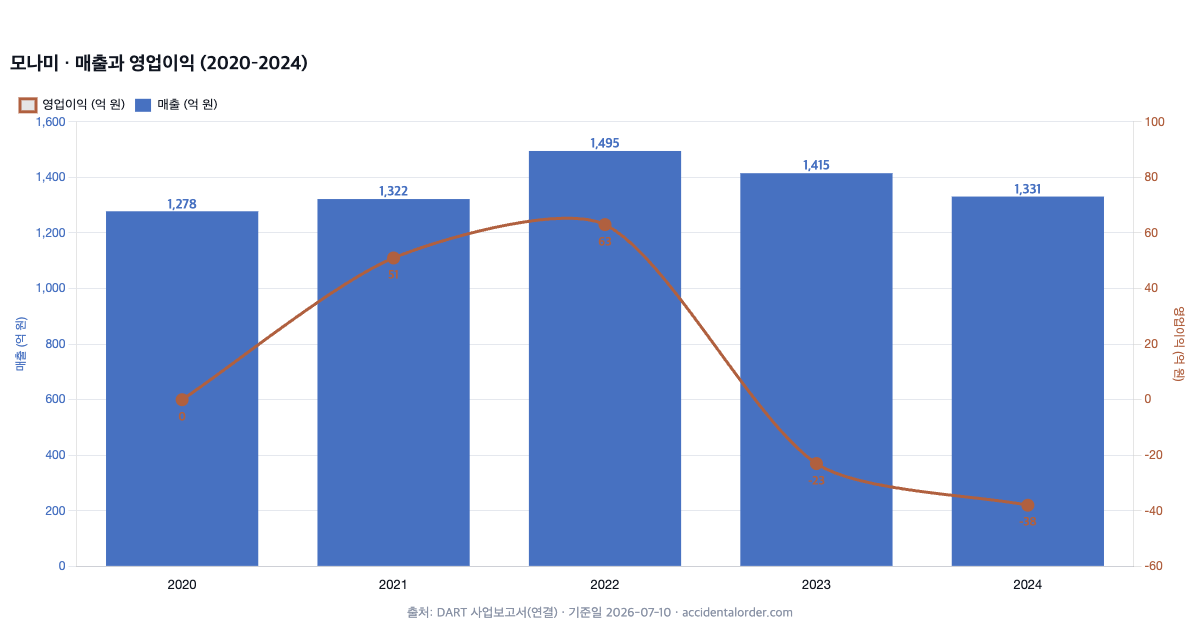
| FY2025 results (consolidated) | Revenue KRW 131.0bn, operating loss KRW 5.9bn, net loss KRW 10.7bn (ROE -13.2%) |
| Financial structure (2025) | Assets KRW 176.3bn / liabilities KRW 95.3bn / equity KRW 81.0bn, debt-to-equity ratio 117.8% |
| Valuation | P/B approx. 0.5x (market capitalisation KRW 40.5bn ÷ equity KRW 81.0bn); P/E meaningless while loss-making |
| Dividend | Around KRW 30 per share (2024), dividend yield in the region of 1% |
1. How the company makes money
The body of Monami is writing instruments and stationery. Pens, symbolised by the “Monami 153” ballpoint, along with markers, highlighters and office and art stationery, hold the number one spot for brand recognition in Korea, and on top of that sit computer consumables (refills, toner and the like) and a distribution business. The problem is that the market this body stands in is itself shrinking. Digitalisation of documents is reducing demand for writing and printing, and the falling school-age population is a structural headwind for the stationery market. The company is aware of this and is opening up new avenues in premium writing instruments, industrial markers, design and concept stores, and overseas markets, but none has yet grown large enough to offset the decline in the core. In short: a company with a strong brand, in a market for that brand that is growing old.
2. The FY2025 numbers: the structure of the loss
| Item | FY2025 (consolidated) |
|---|---|
| Revenue | KRW 131.0bn |
| Operating profit/loss | -KRW 5.9bn (operating loss) |
| Net profit/loss | -KRW 10.7bn (net loss) |
| ROE | -13.2% |
| Total equity | KRW 81.0bn |
Revenue is broadly flat, but the key point is that the operating line has swung into loss. When revenue stalls or falls on top of a fixed-cost structure of labour costs and SG&A, operating leverage works in reverse and profit is the first thing to give way. The fact that the net loss (-KRW 10.7bn) is larger than the operating loss (-KRW 5.9bn) means non-operating items (valuation, disposal, financial gains and losses and so on) piled on as well, so the basic discipline of analysis is to separate, in the next quarter, whether those losses are one-off or recurring. More important than the loss itself is the direction of the loss — whether the shortfall is narrowing or setting hard.
3. The new variable: the market-cap threshold for delisting
Under the delisting-rule reform announced by the Financial Services Commission (Korea’s top financial regulator) in February 2026, the KOSPI’s market-capitalisation threshold for expulsion rises in stages. In July 2026 it went from KRW 20bn to KRW 30bn, and in January 2027 it is due to rise again to KRW 50bn (a company that fails to recover the threshold market capitalisation within the grace period after being designated an administrative-issue stock proceeds towards delisting). It is not profit or equity but “the price the market puts on the company” that has become a condition of staying listed.
For Monami this is not a one-off event but a recurring threshold. Solidarity buying cleared the KRW 30bn bar, but a market capitalisation of about KRW 40.5bn still falls short of the KRW 50bn threshold that arrives in January 2027. Which is to say: unless the company can lift its own valuation through earnings, the same crisis returns early next year at a higher bar. That is why, with this stock, you have to watch whether the market capitalisation stands above the threshold line under its own power as closely as you watch the financial statements.
4. How to read “solidarity buying”
This surge was not the traditional good news of an earnings improvement or a new-business announcement; it was a supply-and-demand phenomenon created by the history of a brand and by public sentiment. Such flows have two faces. Seen positively, solidarity buying buys the company time and options — while the listing holds, capital-raising cards such as a rights issue or asset sales remain live, and that time leaves room for a genuine turnaround to take place. Seen negatively, a price made by sentiment retraces when sentiment cools. Solidarity buying is flow, not fundamentals, and flow cannot prove its own durability. So today’s price carries a premium that earnings do not explain, and that premium will be tested by the next quarter’s results and by the path of the market capitalisation.
5. Bull case
① Cheap against net assets — a market capitalisation of KRW 40.5bn is about half of total equity of KRW 81.0bn (a P/B of roughly 0.5x). If the brand and the assets on hand are fully reflected in the books, this may be a zone where the downside is partly cushioned by assets. ② A brand that cannot be replicated — “Monami” is a national brand that runs across generations, and in consumer goods recognition is a moat that is not easily built; this episode of solidarity buying is itself evidence of that brand equity. ③ Time bought — if the listing is secured, time for capital raising and business restructuring opens up, and an earnings recovery from a lowered base can lead to a valuation re-rating.
6. Bear case
① Structural decline in demand — digitalisation and the shrinking school-age population are trends that are hard to reverse, and in a shrinking market “cheap” carries the risk of getting cheaper as time passes (the value trap). ② Losses and debt — repeated operating losses erode equity, and on top of a debt-to-equity ratio of 117.8% the burden of interest and working capital grows. ③ A rising bar — the 2027 market-cap threshold of KRW 50bn sits above the current market capitalisation of KRW 40.5bn, so unless earnings turn, delisting risk recurs at a higher level. ④ The unwinding of flow — a price made by solidarity buying can fall away when sentiment cools, and what is left then is the fundamentals of a loss-making company. ⑤ Durability of the dividend — a dividend paid during a period of net losses is both a signal of commitment to shareholder returns and a cash outflow, so unless earnings turn there is a risk of it being cut or suspended.
7. The valuation frame: assets, earnings, or flow?
For a loss-making company an earnings-based multiple (P/E) is meaningless, so one side of the scale holds assets (P/B). A P/B of 0.5x means “half the price of the assets”, but for an asset-play argument to hold two things are needed — the quality of the assets (whether they are liquid, like cash or property) and a route by which those assets come back as profit. Without the latter, a low P/B is not a “cheap price” but the probability of extinction as priced by the market. On top of that there is now a third element, a flow premium. So the variables that set this stock’s price come in three layers — over the long run, a swing in operating profit to positive; over the medium term, holding market capitalisation above the threshold line; and over the short term, the persistence of the solidarity-buying flow. The question an investor has to answer for themselves is: which of these three is today’s price leaning on?
8. Quarterly checkpoints
| What to check | Where | What to look for |
|---|---|---|
| Market capitalisation | Daily quotes | Whether it holds above the KRW 30bn (current) and KRW 50bn (2027) threshold lines |
| Operating profit/loss | Quarterly results (DART) | Narrowing loss → signs of a swing to profit |
| Revenue trend | Results announcements | Whether the decline in the core has stopped |
| Share of new businesses | Annual report | Revenue contribution from premium, industrial and overseas |
| Equity and liabilities | Balance sheet | Whether equity is being impaired; direction of the debt-to-equity ratio |
| Dividend policy | Dividend disclosures | Maintained / cut / suspended |
What to watch next quarter
There are two things to look for in the August half-year report (banyeon bogoseo, filed within 45 days of the H1 close) covering Q2 results. ① Whether market capitalisation stays above the delisting threshold line (currently KRW 30bn, rising to KRW 50bn in 2027). ② Whether operating profit/loss is heading towards a narrower loss or a swing into profit. These two are the core variables of this stock’s scenario. Once the results are out we will update this article and stock tracking.
Summing up
We are recording Monami not because it is a “good company”, but because it is a rare specimen that shows an undervalued asset play, a value trap, and a price made by flow all on one screen. Solidarity buying bought the company time, but it did not change the earnings. Whether the stalled engine turns again during that bought time — whether operating profit swings positive and market capitalisation stands above the threshold line under its own power — is what we will update in a single line each quarter; that is how to use this stock. A cheap price is not by itself a margin of safety, and a price made by sentiment is even less so.
Sources: Monami 2025 annual report and financial statements (DART), Financial Services Commission delisting-rule reform plan (2026-02), and press reports. Share price and market capitalisation as of 10 July 2026.
Disclaimer: this article is general information and educational material based on publicly available sources, and is not a recommendation to buy or sell any particular security. The figures stated are as of the time of writing and may change thereafter. Investment decisions and their consequences rest with the investor.
Update log
- 2026-08-15 — FY2026 half-year update — FY2026 half-year report filed — revenue KRW 61.7bn (KRW 65.3bn a year earlier), operating profit KRW -4.0bn (KRW -2.4bn a year earlier), net profit KRW -5.3bn (KRW -5.0bn a year earlier). Threshold (1), market capitalisation against the delisting lines: KRW 31.7bn on the 2026-08-14 base date, above the KRW 30bn line in force and below the KRW 50bn line that applies from 2027. Threshold (2), the operating loss narrowing or turning positive: the half-year cumulative operating loss is KRW 3.97bn against KRW 2.35bn a year earlier, so below the threshold. Status: mixed. → the half-year report · Stock Tracking
- 2026-08-15 — Each company covered here now has its own filing-traceable data page: price-to-book against total equity and against the owners’ share, five years of revenue, profit, equity and net cash, and the dividend, treasury and cancellation record — every figure beside the DART receipt it was read from. → Monami (005360)
Get the next quarterly update for this company by email
When the next results are filed we send where this scenario stands. Nothing else.