SK Hynix Filed a KRW 40tn Buyback and a Cancellation on the Same Day. That Pairing Is the Whole Point.
What was filed
On 19 August 2026 SK Hynix’s board met and three documents went onto DART the same day.
A share cancellation decision (20260819800340). It names 24,070,000 common shares for cancellation against an issued count of 730,492,365, at a stated amount of KRW 40,004,340,000,000. That is 3.295% of the company, and roughly USD 28.3bn at the exchange rate our dataset uses for its 14 August base date.
A material-event report on a treasury share acquisition (20260819000254). Same 24,070,000 shares, same KRW 40,004,340,000,000. Acquisition window 20 August to 19 November 2026, on-market purchase, brokered by SK Securities. Stated purpose, in the filing’s own words: to enhance shareholder value through cancellation of treasury shares.
A fair-disclosure filing on the shareholder-return policy (20260819800338). It sets out a 2025–2027 policy of returning at least 50% of cumulative free cash flow, combining buy-and-cancel with cash dividends, and gives the company’s stated reason for acting now: it judged that “the recent share price is undervalued relative to the company’s intrinsic value” — the company’s assessment, quoted from its filing, not ours.
Neither share count is final. Both filings say the same thing about it: 24,070,000 is the number KRW 40,004,340,000,000 buys at the 18 August closing price of KRW 1,662,000, the actual count will move with the price during the purchase window, and a corrected filing will follow with the real figure.
Why two filings and not one
Because they are two different corporate acts, and Korean disclosure rules treat them as such.
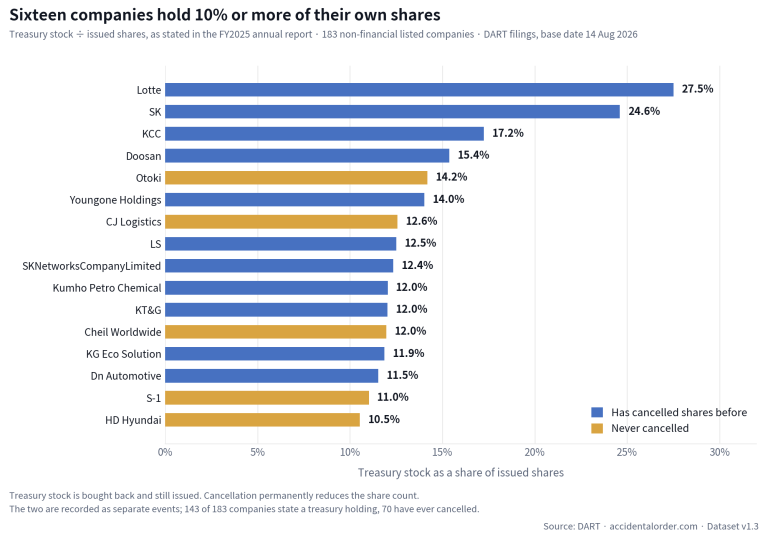
This is the distinction the brief published earlier today was about, and SK Hynix has now supplied an unusually clean illustration of it. Buying shares back moves them from the market onto the company’s own balance sheet, where they still exist and can still come back out. Cancelling them ends them. A company can do the first without ever doing the second — 12 of the 32 Korean companies holding 5% or more of their own stock have never once cancelled.
SK Hynix filed both, and made the link explicit in the text. The acquisition filing states that because this purchase is for the purpose of cancellation, the company will cancel the entire quantity acquired during the window once the purchase is complete, and points the reader at the cancellation filing of the same date. The cancellation filing points back.
The cancellation filing also names the legal mechanism, and it is worth reading slowly: the cancellation is made under the proviso to Article 343(1) of the Commercial Act, using treasury shares acquired within distributable profit, so the issued share count falls but capital stock does not. Par value is KRW 5,000 and stays there; what shrinks is the number of shares the par value is multiplied across. After cancellation the issued count becomes 706,422,365.
The size, in the filing’s own terms
The acquisition filing carries the arithmetic that bounds it. Distributable profit at the last financial year end is stated as KRW 91,554,763,368,271 — net assets of KRW 117,318,562,193,943, less capital stock of KRW 3,657,652,050,000, less accumulated capital and earnings reserves of KRW 9,867,146,544,188, less unrealised gains of KRW 12,239,000,231,484.
The KRW 40tn commitment is 43.7% of that ceiling.
There is a second constraint in the filing: a daily purchase-order cap of 2,407,000 shares. The filing shows the calculation — the larger of 10% of the registered quantity (2,407,000) and 25% of the past month’s average daily volume (1,431,989), then capped at 1% of issued shares (7,304,923). At the cap, 24,070,000 shares is ten trading days of buying inside a window that runs about three months.
This is the second cancellation this year
The register makes that easy to miss, so it is worth setting out.
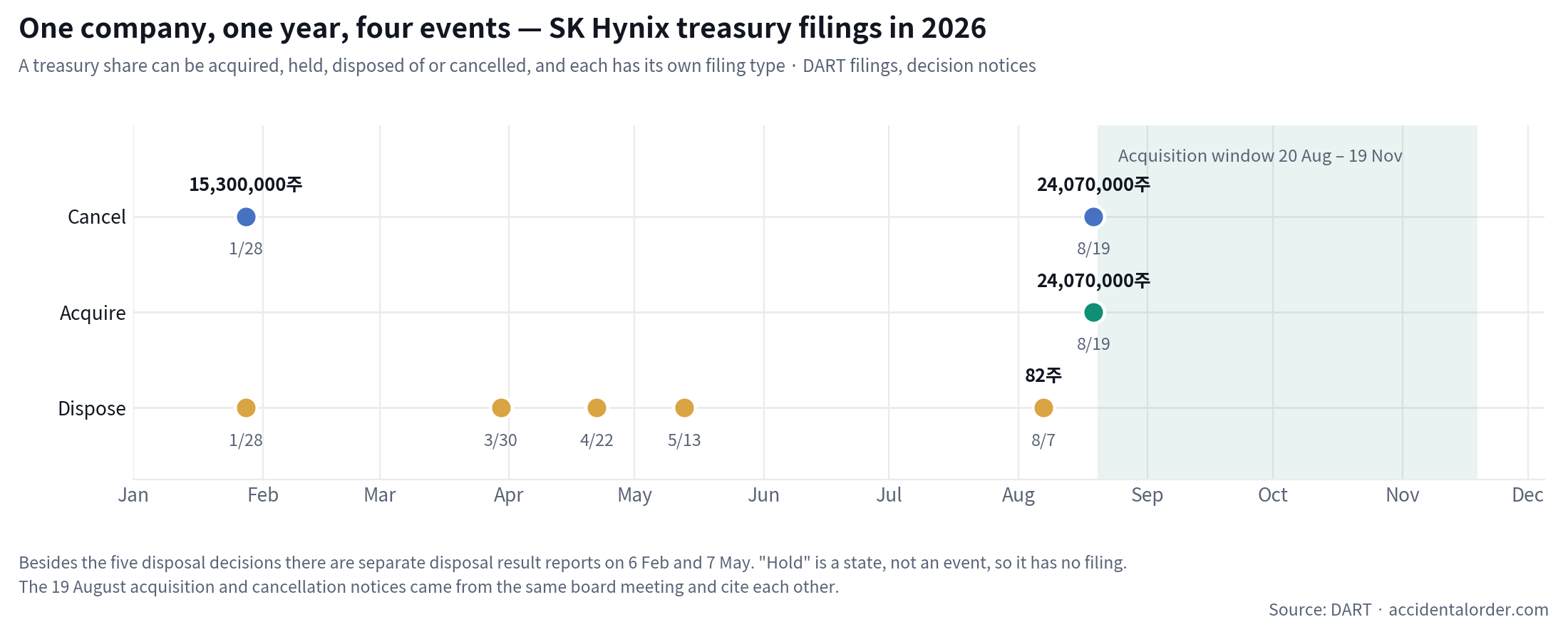
On 28 January 2026 SK Hynix filed a separate cancellation decision (20260128800616): 15,300,000 shares, KRW 12,240,000,000,000 at the previous day’s close of KRW 800,000, cancelled on 9 February. That one used shares already held rather than shares still to be bought — the filing’s method field reads “previously acquired treasury shares,” with no acquisition window at all. Issued count went from 728,002,365 to 712,702,365.
Two cancellations in one year, then: 15,300,000 shares in February and 24,070,000 more to come, 39,370,000 shares and KRW 52.24tn in total.
And a third kind of event, which is neither
Between those two cancellations the register shows something else entirely: treasury share disposal decisions on 28 January, 30 March, 22 April, 13 May and 7 August, plus disposal result reports in February and May.
A disposal is the mirror of a cancellation. It takes treasury shares off the company’s books and puts them back into someone’s hands — the share count does not fall, and in the disposal’s case the float can rise. The 7 August filing (20260807000537) is a good miniature of why these need their own column: 82 shares, KRW 122,590,000, disposed to independent directors as director remuneration.
So across 2026 a single company filed all four of the events a treasury share can undergo — acquire, hold, dispose, cancel — and each one has its own filing type. Any dataset with a single “buyback” column loses three of the four.
What this does to our own published figure
Our dataset says SK Hynix holds 3.61% of itself in treasury. The filing two days ago says 0.22%. Both are correct, and the gap is the point.
The 3.61% comes from the share-count table in the FY2025 annual report (20260317000635) — 26,310,845 shares — and that table reports the position at the financial year end, 31 December 2025. The 8/19 figure of 1,625,696 shares plus 73 others is the position on the day the board met. In between sit the February cancellation and five disposals. The difference is 24,685,076 shares.
This is exactly the rule the brief published this morning set out, arriving to be tested the same week: a ratio is only as coherent as the pairing that produced it, and a treasury figure read from an annual report belongs to the annual report’s date, not to today’s. Our column is dated and labelled as such. It is not a live position, and after 19 November it will be further from one still — which is what the quarterly update cycle is for.
What this brief does not say
It does not say whether KRW 40tn is well spent, what it does to the share price, or whether cancelling is better than holding. The company’s own stated reason is quoted above and attributed to the company. Everything else here is a filed number with a receipt number attached.
Nothing here is a recommendation to buy or sell any security.
Sources
Every figure above comes from these five filings, all retrievable by receipt number on DART.
- 20260819800340 — Share cancellation decision, 19 Aug 2026
- 20260819000254 — Material-event report, treasury share acquisition, 19 Aug 2026
- 20260819800338 — Fair disclosure, shareholder-return policy, 19 Aug 2026
- 20260128800616 — Share cancellation decision, 28 Jan 2026
- 20260807000537 — Treasury share disposal decision, 7 Aug 2026
- SK Hynix (000660) in the data room · the full 183-company table
Source: DART filings · Dataset v1.3 · Base date 14 August 2026 · Next update: Q3 filings (Nov 2026). This is a record of what the filings say. It is not a recommendation to buy or sell any security, it carries no price target and no view on where any share price is going.
Get the next quarterly update for this company by email
When the next results are filed we send where this scenario stands. Nothing else.