Bought Back, and Then What? Treasury Stock and Cancellation at 183 Korean Companies
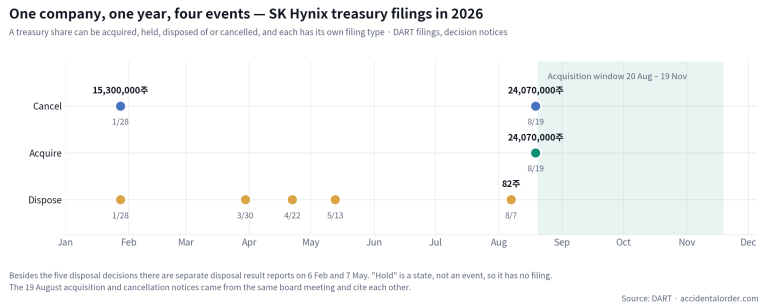
A company buys its own shares on the market. What happens next is one of two things, and the filings record them as separate events.
It can hold them. The shares sit on the balance sheet as treasury stock. They are still issued. They carry no vote and receive no dividend while the company holds them, but they can be sold back into the market later, handed over in an acquisition, or given to employees. The share count is unchanged.
Or it can cancel them. The shares stop existing. The issued share count falls and does not come back. Every per-share figure — earnings per share, book value per share, dividend per share — is computed against a smaller denominator from that point on.
The distinction is mechanical, not editorial, and this brief takes no position on which a company should do. What it does is separate the two in 183 companies’ filings, because a great deal of public discussion treats “the company bought back shares” as one event when the filings clearly record two.
What the filings say
On 14 August 2026, treasury holdings can be read from the annual report for 143 of 183 companies. Of those, 138 hold some quantity of their own shares and five hold none at all.
| Treasury stock as a share of issued stock | Companies |
|---|---|
| Exactly zero | 5 |
| Above 0%, under 5% | 106 |
| 5% to 10% | 16 |
| 10% to 20% | 14 |
| Above 20% | 2 |
Separately, 70 of the 183 have cancelled shares at some point on the record we collect. Grouped by the most recent cancellation on file: 47 companies most recently in 2026, 16 in 2025, six in 2024, and one in 2023.
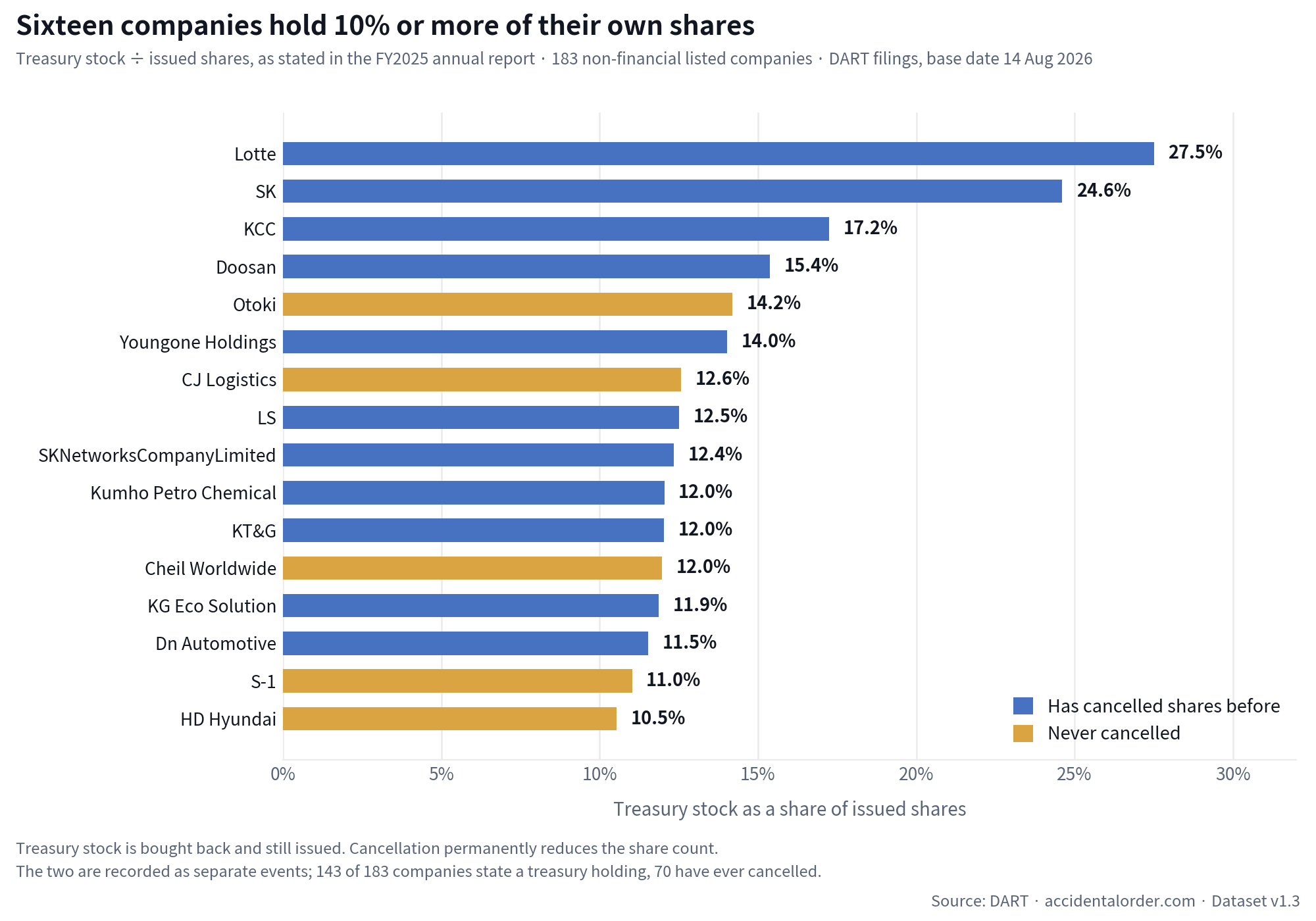
Here is every company holding 10% or more of its own issued shares, with whether a cancellation appears anywhere in its record.
| # | Company | Ticker | Treasury % | Ever cancelled | Most recent |
|---|---|---|---|---|---|
| 1 | Lotte | 004990 | 27.51% | Yes | 2026 |
| 2 | SK | 034730 | 24.61% | Yes | 2026 |
| 3 | KCC | 002380 | 17.24% | Yes | 2026 |
| 4 | Doosan | 000150 | 15.38% | Yes | 2025 |
| 5 | Otoki | 007310 | 14.18% | No | — |
| 6 | Youngone Holdings | 009970 | 14.03% | Yes | 2026 |
| 7 | CJ Logistics | 000120 | 12.57% | No | — |
| 8 | LS | 006260 | 12.51% | Yes | 2026 |
| 9 | SKNetworksCompanyLimited | 001740 | 12.35% | Yes | 2026 |
| 10 | Kumho Petro Chemical | 011780 | 12.04% | Yes | 2026 |
| 11 | KT&G | 033780 | 12.03% | Yes | 2026 |
| 12 | Cheil Worldwide | 030000 | 11.96% | No | — |
| 13 | KG Eco Solution | 151860 | 11.86% | Yes | 2025 |
| 14 | Dn Automotive | 007340 | 11.53% | Yes | 2025 |
| 15 | S-1 | 012750 | 11.02% | No | — |
| 16 | HD Hyundai | 267250 | 10.54% | No | — |
Lotte holds 28,858,476 of its 104,909,237 issued shares. SK holds 17,982,486 of 73,068,838. Both figures are read from the share-count table in the FY2025 annual report, and both companies also cancelled shares during 2026 — the holding and the cancellation are not alternatives, and several companies on this list did both.
The two mirror groups
Widen from ten percent to five, and 32 companies qualify. Twenty of them have cancelled shares at some point. Twelve never have.
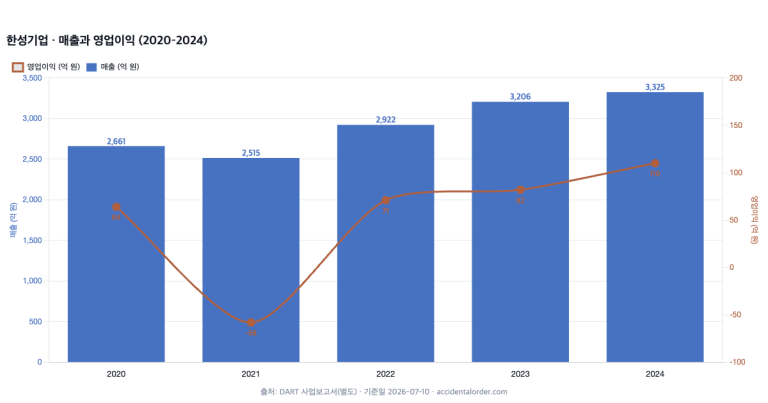
Those twelve: Otoki (14.18%), CJ Logistics (12.57%), Cheil Worldwide (11.96%), S-1 (11.02%), HD Hyundai (10.54%), Hansung Enterprise (9.04%), CJ (7.26%), Lx International (7.20%), Kangwon Land (6.60%), KoreaGas (5.46%), Hotel Shilla (5.44%), Muhak (5.36%).
The mirror image is a group of the same rough size. Eighteen companies have cancelled shares and now hold under 1% — they bought and retired rather than bought and kept. Three of them are down to token amounts that round to nothing at all: Korean Air Lines holds 51 shares, LG Chem holds two, Hanjinkal holds one. The rest — SK Innovation, Hanon Systems, LG Electronics, HD Construction Equipment, Orion, GS Holdings, Hyosung, Doosan Bobcat, SK Square, Kia, Hanmi Semiconductor, Hyundai Motor, SK Telecom, LG Uplus, Hanmi Science — hold fractions of a percent.
Both groups are visible only because holdings and cancellations are recorded as separate columns. A dataset carrying one “buyback” column would collapse them into the same row.
The trap in this column: the denominator decides the number
Every brief in this series carries the part where we show what nearly went wrong. This one is about a division.
Treasury stock as a percentage is a ratio, and the numerator is easy — the annual report states the treasury share count directly. The denominator is where the choice is, and there are two candidates that both look correct:
- the issued share count printed in the same annual report, or
- the listed share count on the base date, which is what market capitalisation, P/B and P/E in this dataset are divided by.
Using the base-date count would be internally tidy: one denominator for every ratio in the dataset. It is also wrong here, and one company shows why with unusual violence.
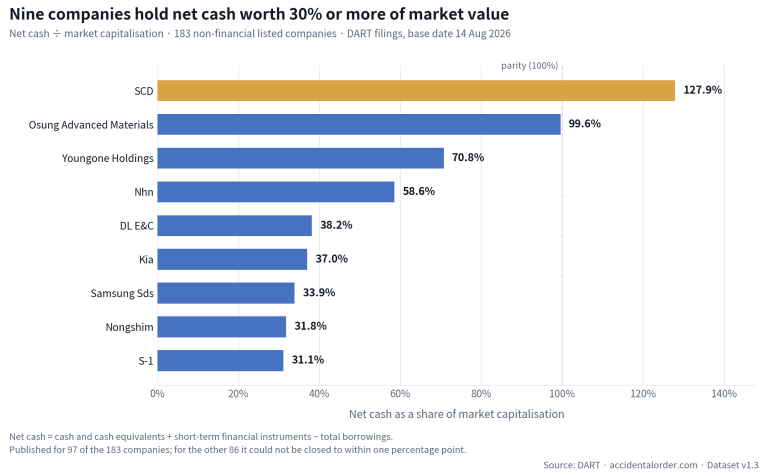
Osung Advanced Materials carried out a ten-to-one share consolidation after its financial year ended. Its FY2025 annual report prints 94,425,682 issued shares. The exchange snapshot on the base date shows 9,742,009. The treasury holding stated in that annual report is a number that belongs to the first of those two worlds. Divide it by the report’s own count and you get 3.61%. Divide it by the base-date count and you get 35.00%.
A 31.4 percentage-point swing, and the larger figure appears in no filing anywhere. It is an artefact of pairing a numerator from one date with a denominator from another.
So the published rule is that treasury percentage uses the issued share count from the same filing the treasury count came from, and a treasury_denom_basis column records which basis each row used. Ten companies move by more than half a point between the two bases; besides Osung, the largest are Doosan (15.38% against 20.03%), Hanwha (5.90% against 7.92%) and Kumho Petro Chemical (12.04% against 13.91%).
This is the same lesson as the previous brief in a different costume. There it was that a threshold should be denominated in the units of the number being published. Here it is that a ratio’s numerator and denominator must come from the same moment. Both are versions of one rule: a figure is only as coherent as the pairing that produced it.
The forty blank rows
Forty of the 183 companies do not state a treasury holding in the standard share-count table of their annual report. Their cells are empty, and the treasury_basis column reads not_stated rather than zero.
Empty is not the same as zero, and the difference matters here more than in most columns. A company that states “treasury stock: 0” is telling you something. A company whose share-count table simply has no such line is telling you nothing, and filling that silence with a zero would manufacture a fact. Seven of those forty have a cancellation on record, which is a reminder that the absence is about presentation, not about inactivity.
One company gets its figure from a different filing entirely: where the share-count table is unusable, the treasury acquisition-and-disposal statement is used instead, and the treasury_basis column says so.
What this is not
This brief has counted shares. It has not said that cancelling is better than holding, that any company on any list above should do something different, or that any of this bears on where a share price goes. Treasury stock is held for reasons a share-count table does not show — a planned acquisition, an employee scheme, a holding-company restructuring, a stake a controlling family finds convenient. A cancellation likewise has causes and consequences the count alone cannot tell you.
Nothing here is a recommendation to buy or sell any security.
What the two columns do is let you ask a specific question of a specific company and get an answer from a filing rather than from a summary.
Where the numbers are
Every figure comes from DART filings, and each company page carries the receipt number of the filing behind its share counts. The full dataset — 38 columns including treasury_shares, treasury_pct, treasury_basis, treasury_denom_basis, cancel_history_yn and last_cancel_year — is available as a CSV. The share-count rules are set out in §8 of the methodology.
- The full table — 183 companies, sortable, with the CSV
- Methodology — §8 sets out the share-count and treasury rules
- The largest holders above: Lotte · SK · KCC · Doosan · Otoki · Youngone Holdings · CJ Logistics · LS
- Brief #2 — When the cash is heavier than the company
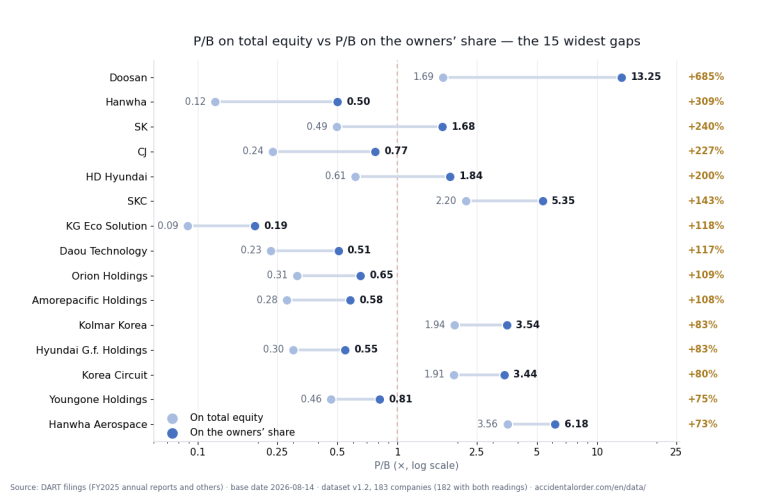
- Brief #1 — The owner’s share
Source: DART filings · Dataset v1.3 (changelog) · Base date 14 August 2026 · Next update: Q3 filings (Nov 2026). This brief is a record of what the filings say. It is not a recommendation to buy or sell any security, it carries no price target and no view on where any share price is going.
Get the next quarterly update for this company by email
When the next results are filed we send where this scenario stands. Nothing else.