Hansung Enterprise (003680): ‘Patriotic Company’ Support Buying and the Homework in Seafood
This is a company analysis, taking listed companies apart one at a time. It is not a recommendation to buy or sell any particular stock, and all figures are as at the time of writing (July 2026) and may change thereafter.
Core scenario: Hansung Enterprise is profitable at the operating line but carries a net loss and falling revenue, and its share price has recently cleared the delisting threshold on the back of “patriotic company” support buying. What matters is (1) the normalisation of net profit and a rebound in revenue, and (2) whether, once the support buying cools, market capitalisation can hold above the threshold (KRW 50bn from 2027) under its own weight. This proposition is updated every quarter in stock tracking.
Why it is in the news now
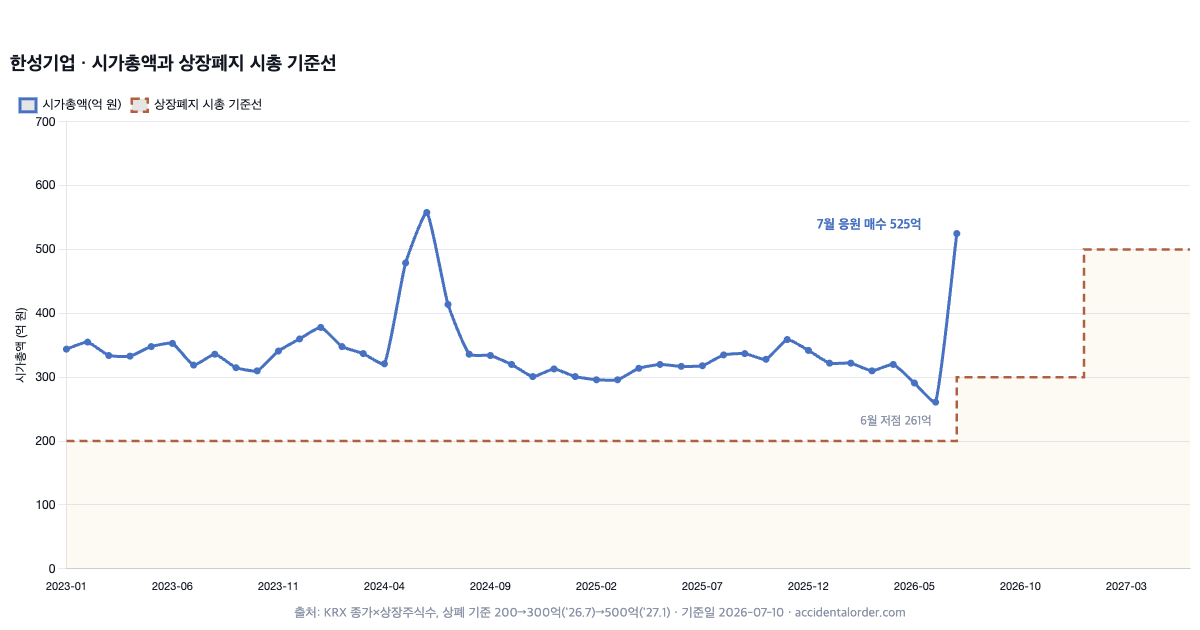
From 1 July 2026 the market-capitalisation threshold for delisting on KOSPI (Korea’s main board) rose from KRW 20bn to KRW 30bn. Hansung Enterprise, with a market capitalisation of about KRW 30.6bn, immediately found itself in the zone of delisting concern. The twist, though, came not from results but from a story. The fact that Hansung Enterprise had sponsored the “Concert for Heroes” for UN Korean War veterans for 25 years running (25 editions) began circulating on social media as the mark of a “patriotic company”, support for it spread, and consumers ran a so-called donjjul campaign — rewarding a company for its conduct by spending money on it — posting proof of product purchases and proof of share purchases at the same time. Some products sold out on the company’s own online store (Hansung Market), and the share price rose more than 50% over four days, with two consecutive limit-up sessions, reaching a 52-week high of KRW 8,460. Market capitalisation recovered from below KRW 30bn to about KRW 52.5bn.
The fundamentals did not improve in the space of a few days. In other words, a support premium that results cannot explain is now sitting on top of the price, and investors have to ask what that premium rests on and when it will be tested.
Company snapshot
| Company | Hansung Enterprise (KOSPI 003680) |
| Founded / business | Founded 1963, seafood products — processed seafood such as Crami (crab-flavoured surimi sticks) and fish cake, plus deep-sea tuna longlining |
| Share price / market capitalisation | About KRW 8,460 / about KRW 52.5bn (2026-07, after the surge in support buying) |
| 52-week move | From the delisting threshold (market capitalisation ~KRW 30.6bn), a surge of more than 50% in four days; new 52-week high |
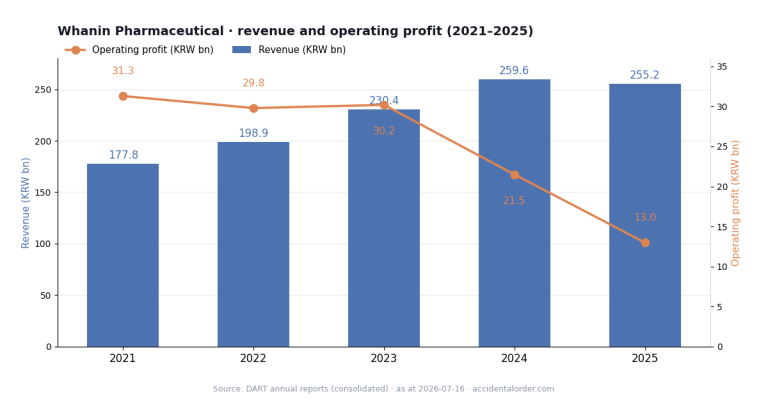
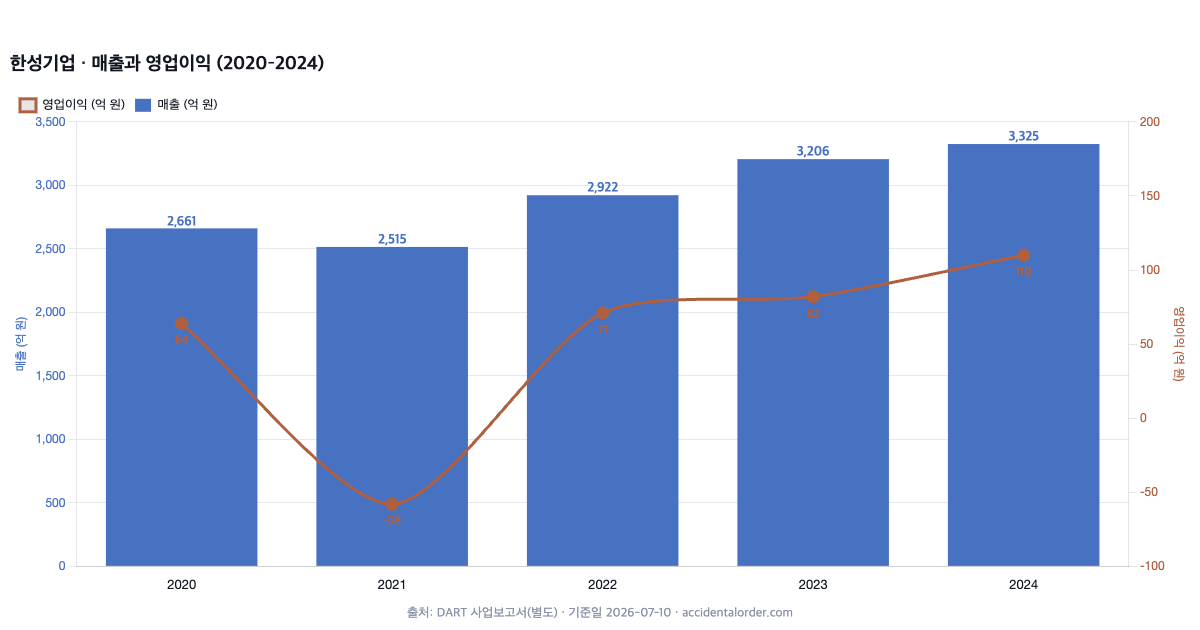
| FY2025 results | Revenue KRW 318.4bn, operating profit KRW 5.8bn (operating margin about 1.8%), net profit swung to a loss |
| Q1 2026 | Revenue −4.2% (YoY), operating profit +12.9%, net profit +75.6% — signs of a recovery in profitability |
| Valuation | PSR about 0.16x (market capitalisation KRW 52.5bn ÷ revenue KRW 318.4bn), characteristic of low-margin food |
1. How the money is made
The body of Hansung Enterprise is seafood products. Processed seafood — crab-flavoured surimi sticks, represented by “Crami”, and fish cake — is the centre of the domestic business, with deep-sea tuna longlining attached to it. Food is a low-margin business whose profitability swings with raw material (seafood) prices and logistics costs, so operating profit (KRW 5.8bn) is thin relative to the scale of revenue (KRW 318.4bn). The company is responding to changing fishing conditions with new premium surimi products such as Monster Crab and Wild Crami, and abroad with a Kiribati joint venture and MSC-certified tuna longliners. In short, this is a traditional seafood-products company with a brand (Crami) and deep-sea assets, defending profitability under cost pressure.
2. The record: profitable but thin, with net profit wobbling
On an FY2025 basis, revenue of KRW 318.4bn produced operating profit of KRW 5.8bn, so the operating line is in the black. But the operating margin is a thin 1.8%, revenue is declining, and net profit swung to a loss (the effect of non-operating items). When a company is profitable at the operating line but loss-making at the bottom, you have to look at “what is leaking below the core business” — finance costs, valuation and disposal gains and losses, equity-method items. The welcome signal is Q1 2026. Revenue still fell (−4.2%), but operating profit improved 12.9% and net profit 75.6%. Whether cost and expense management is coming back through as profitability is the point to watch in the coming quarters.
3. A new variable: the market-capitalisation delisting threshold
Under the Financial Services Commission’s February 2026 reform of the delisting regime, KOSPI’s market-capitalisation exit threshold rises in stages. It went from KRW 20bn to KRW 30bn in July 2026, and is due to be raised again to KRW 50bn in January 2027. It amounts to making “the price the market puts on the company” itself, rather than profit or equity, a condition of staying listed. Hansung Enterprise has come through the KRW 30bn threshold on support buying to a market capitalisation of about KRW 52.5bn, but that only just clears the KRW 50bn threshold of 2027. If, once the support buying cools, results cannot hold that valuation up unaided, the higher threshold comes round again.
4. How to read the “support buying”
The surge in Hansung Enterprise was a phenomenon in which consumption and investment responded together to a “patriotic company” narrative. A flow in which people buy the shares while buying the products is an unusual event, brand loyalty and capital inflow overlapping — but from an analytical point of view it is, in the end, supply and demand. Seen positively, the support buying handed the company time to stay listed and the intangible asset of a brand brought back into the light. Seen negatively, a price made by sentiment returns when the sentiment cools, and what is left in its place is the homework of the core business: thin margins and falling revenue. The share price today sits between these two forces.
5. Bull Case
① Operating profit and signs of recovery — this is not a loss-making company but one that earns in its core business, and both operating profit and net profit improved markedly in Q1 2026. ② Brand and renewed attention — “Crami” is the brand that represents its category, and this “patriotic company” episode has reignited consumer interest. ③ Deep-sea and overseas assets — tuna longlining, the overseas joint venture (Kiribati) and MSC certification are both a response to changing fishing conditions and an asset. ④ A low PSR — market capitalisation against revenue (PSR about 0.16x) is low, so once net profit normalises the earnings-based valuation could quickly come to look cheap.
6. Bear Case
① Thin margins and cost volatility — an operating margin of about 1.8% is easily shaken by seafood prices, logistics costs and exchange rates, and a single cost spike wipes out the profit. ② Falling revenue — the top line of the core business is shrinking, so an improvement in profitability that does not carry through into a revenue rebound is only half the job. ③ The net loss — if the items leaking below the operating line (finance, valuation and the like) recur, equity is ground down. ④ A rising threshold — a market capitalisation of KRW 52.5bn only just clears the KRW 50bn threshold of 2027, so if the share price falls back to where it was before the support buying, delisting risk returns. ⑤ A reversal in supply and demand — support buying is sentiment, not fundamentals, and a substantial part of the surge can be given back.
7. A valuation frame
Because the operating line is profitable, earnings-based measures can be used, but net profit wobbles and so the PER is unstable. The scales therefore carry both the price against revenue (PSR about 0.16x) and the path to normalising net profit. For low-margin food a low PSR is normal, so the mere fact that it is low is not evidence of undervaluation — what matters is whether the thin margin thickens. On top of this sits the premium created by the support buying, so the price is determined in three layers: over the long run, the normalisation of net profit; over the medium term, holding market capitalisation above the threshold; over the short term, the persistence of the support buying. Distinguishing which of the three layers today’s price is leaning on is how this company is to be used.
8. Quarterly checkpoints
| What to check | Where | What to look for |
|---|---|---|
| Market capitalisation | Daily prices | Holding above the thresholds of KRW 30bn (current) and KRW 50bn (2027) |
| Net profit | Quarterly results (DART) | Whether the loss normalises into a profit |
| Operating margin | Results announcements | Direction of margins against raw material and logistics costs |
| Revenue trend | Results announcements | Whether the decline in the top line has stopped |
| Overseas and deep-sea | Annual report | Contribution from tuna and the overseas joint venture |
| Equity and liabilities | Balance sheet | Any capital impairment; direction of the debt-to-equity ratio |
What to watch next quarter
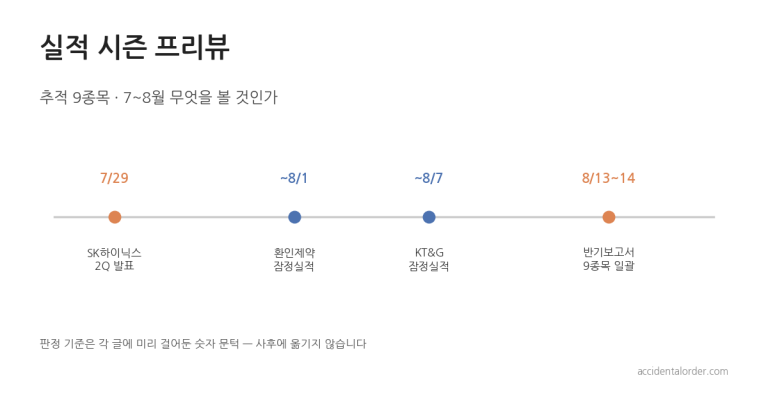
Two things to look for in the August half-year report (banyeon bogoseo, filed within 45 days of the H1 close), covering Q2 results. ① Whether market capitalisation stays above the delisting thresholds (KRW 30bn currently, KRW 50bn from 2027). ② Whether net profit is heading from loss towards normalised profit. These two are the key variables in this company’s scenario. Once the results are out, this article and stock tracking will be updated.
In closing
Hansung Enterprise is worth recording because “an episode in which a story moved a share price” and “the homework of the core business” overlap on a single screen. The support buying handed the company time to stay listed and brought its brand back into the light, but it does not solve the core business’s problems — falling revenue and thin margins — on the company’s behalf. Updating, in one line each quarter, whether net profit finds its footing during the time thus bought and whether market capitalisation stands above the threshold under its own power: that is how this company is to be used. Being a good corporate citizen and being a good investment sit on separate scales.
Sources: Hansung Enterprise 2025 annual report and Q1 2026 quarterly report (DART), the Financial Services Commission’s delisting regime reform plan (2026-02), and press reports. The share price and market capitalisation are as at July 2026.
Disclaimer: this article is general information and educational material based on publicly available information, and is not a recommendation to buy or sell any particular security. The figures given are as at the time of writing and may change thereafter. Investment decisions and the responsibility for them rest with the investor.
Update log
- 2026-08-15 — FY2026 half-year update — The FY2026 half-year report was filed on 14 August 2026 (receipt 20260814001208). Its financial statements have not yet appeared in the DART financial API — neither the full nor the summary endpoint returns data, on either a consolidated or a separate basis — so no half-year figures are recorded in this update. Nothing has been substituted for them; the reading against the threshold ((1) market capitalisation above the delisting thresholds (2) net profit moving from loss back to profit) will be added to this log once the data appears. Status: awaiting data. For reference, market capitalisation on the 2026-08-14 base date was KRW 36.6bn — above the KRW 30bn line in force, below the KRW 50bn line that applies from 2027. → the half-year report · Stock Tracking
- 2026-08-15 — Each company covered here now has its own filing-traceable data page: price-to-book against total equity and against the owners’ share, five years of revenue, profit, equity and net cash, and the dividend, treasury and cancellation record — every figure beside the DART receipt it was read from. → Hansung Enterprise (003680)
Get the next quarterly update for this company by email
When the next results are filed we send where this scenario stands. Nothing else.