Muhak (033920): Net Cash Bigger Than the Market Cap, and the Quality of That Cash
This is a company analysis, taking listed companies apart one at a time. It is not a recommendation to buy or sell any particular stock, and all figures are as at the time of writing (July 2026) and may change thereafter. Core scenario: operating profit from the core business (soju and bottled water) is sustained, and the accumulated net cash continues to be transferred to shareholders through dividends and buybacks — this proposition is updated every quarter in stock tracking.
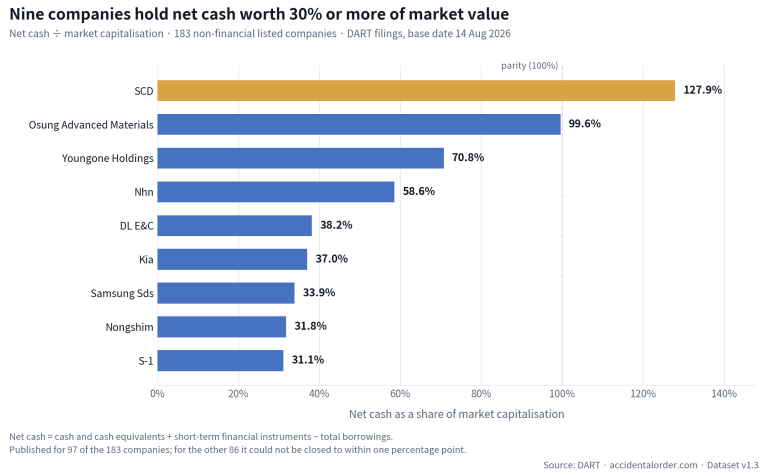
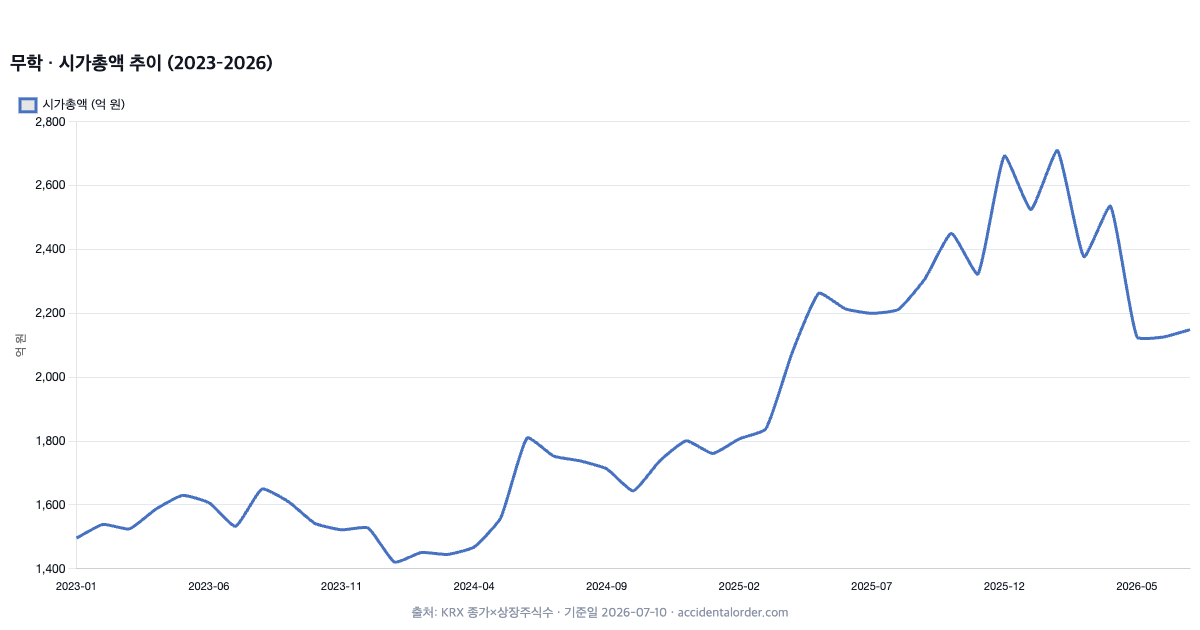
Muhak is a soju maker based in South Gyeongsang province and Busan. Soju brands such as Joeunday and Daejangbu, together with bottled water, are the pillars of its revenue. Market capitalisation is about KRW 214.9bn, the PBR 0.38x and the PER 4.4x. With net cash-like assets larger than its market capitalisation, it wears the classic face of an asset play. Yet its net profit swings between a loss in some years and KRW 65.4bn in others. Understanding what lies behind that amplitude is where reading Muhak begins.
How the money is made
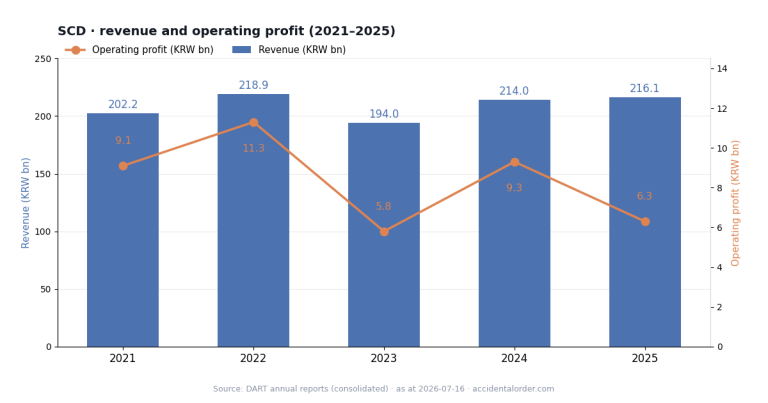
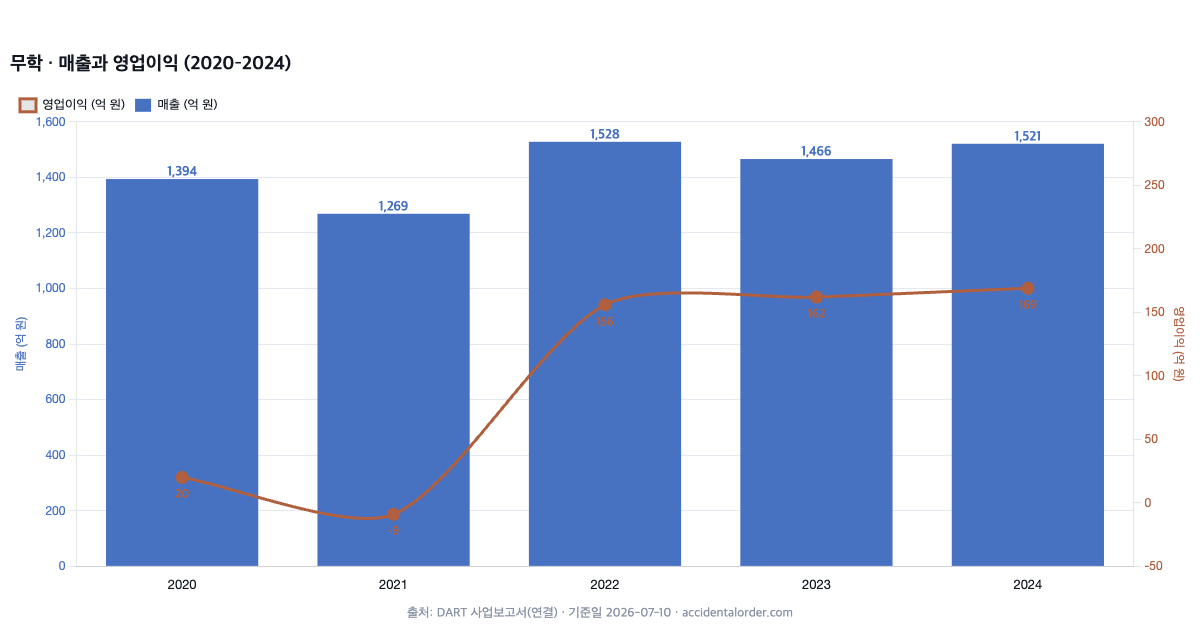
Muhak’s core business is regional soju. Pushed back by the national leader (HiteJinro), its nationwide share is low, but it still carries weight in South Gyeongsang province and Busan. A bottled-water business sits alongside it. Revenue recovered gently from KRW 139.4bn in 2020 to KRW 152.1bn in 2024, passing through the pandemic-era trough (KRW 126.9bn in 2021). Operating profit went as far as a loss of KRW 0.9bn in 2021, then from 2022 moved into a stable profitable range of KRW 15.6bn → KRW 16.2bn → KRW 16.9bn. On the core business alone, this is “a dull company that makes a profit.”
Muhak is a regional soju maker based in South Gyeongsang province and Busan. Its flagship brand is the Joeunday line, and it also runs a bottled-water business. It has defended a leading share in its regional market, but on a nationwide view it sits on a minor share behind the larger players. That its revenue is rooted in one particular region means stability and limitation at the same time. Ownership is firmly in the founding family’s hands: chairman Choi Jae-ho holds 34.78%, and adding related parties takes the largest-shareholder side to about 50%. It is a structure in which decisions on shareholder returns such as dividends and buybacks can be taken relatively quickly.
Five-year results summary (KRW bn)
| Year | 2020 | 2021 | 2022 | 2023 | 2024 |
|---|---|---|---|---|---|
| Revenue | 139.4 | 126.9 | 152.8 | 146.6 | 152.1 |
| Operating profit | 2.0 | −0.9 | 15.6 | 16.2 | 16.9 |
| Net profit | 13.2 | −16.0 | −13.2 | 65.4 | 48.4 |
Two currents stand in contrast in the table. Operating profit climbed gently from 2022 onwards — KRW 15.6bn → 16.2bn → 16.9bn — showing that the core business has settled into a stable profit-making structure. Net profit, by contrast, rebounded sharply from losses of KRW 16.0bn in 2021 and KRW 13.2bn in 2022 to KRW 65.4bn and KRW 48.4bn in 2023 and 2024. The stability of core operating profit and the wide amplitude of net profit do not line up, and that gap is precisely the key to understanding Muhak.
Pressure point — the quality of the net cash
Muhak’s net profit moves separately from its core business. In 2021 and 2022 operating profit was positive, yet net profit was a loss of KRW 16.0bn and KRW 13.2bn respectively. Conversely, in 2023 net profit jumped as high as KRW 65.4bn. The cause of that amplitude is not operations but the large portfolio of marketable financial assets the company holds. As at the end of 2024, alongside cash and cash equivalents of KRW 243.3bn, Muhak held about KRW 166.2bn of financial assets measured at fair value through profit or loss. Valuation and disposal gains and losses on those assets shake net profit up and down every year. The cash flow statement likewise picks up a KRW 45.7bn gain on disposal of financial assets at fair value through profit or loss, along with valuation adjustments.
In other words, Muhak’s “net cash” is not deposits sleeping in a bank; a substantial part of it consists of equity and fund-type assets. This cuts both ways. The assets themselves are thick (net cash-like assets of about KRW 374.5bn > market capitalisation of KRW 214.9bn), but their value swings with the market and shows up as volatility in net profit. The PER of 4.4x, too, is calculated on the net profit of a year when gains on financial assets were good, and so is hard to take at face value.
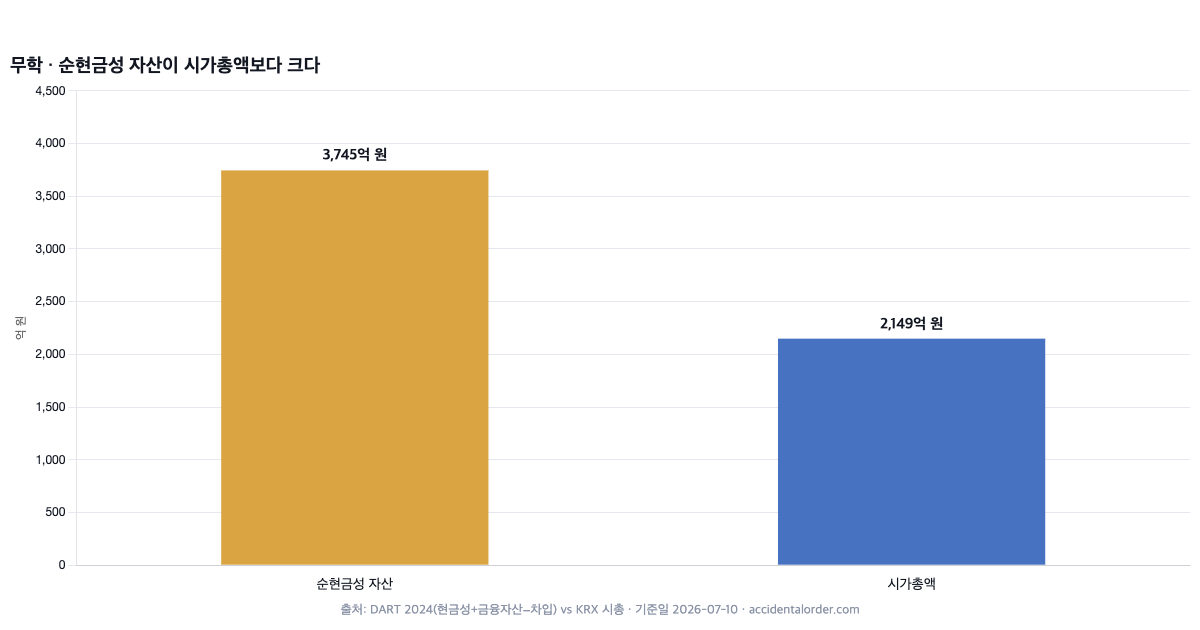
The reason net profit swings so widely lies not in the core business but in the large portfolio of marketable financial assets Muhak holds. As at the end of 2024, in addition to cash and cash equivalents of about KRW 243.3bn, there were about KRW 166.2bn of financial assets classified at fair value through profit or loss and KRW 7.0bn of short-term financial instruments. Borrowings, including bonds, came to only about KRW 42.0bn, so net cash-like assets after offsetting them reach about KRW 374.5bn. That is more than the market capitalisation of about KRW 214.9bn on the date of publication — meaning the company’s cash-like assets alone exceed what the whole company is priced at.
The “quality” of that cash has to be examined, though, because a substantial part of the net cash is not bank deposits but equity and fund-type financial assets. The 2024 cash flow statement records items such as a KRW 45.7bn gain on disposal of financial assets at fair value through profit or loss, and it is precisely these valuation and disposal gains and losses that have shaken net profit the most. Because the structure inflates net profit when markets are good and deflates it through valuation losses when they are bad, judging this company on net profit alone leads easily to a misreading. That is why “the quality of the net cash” is this company’s first pressure point.
The core scenario and what would falsify it
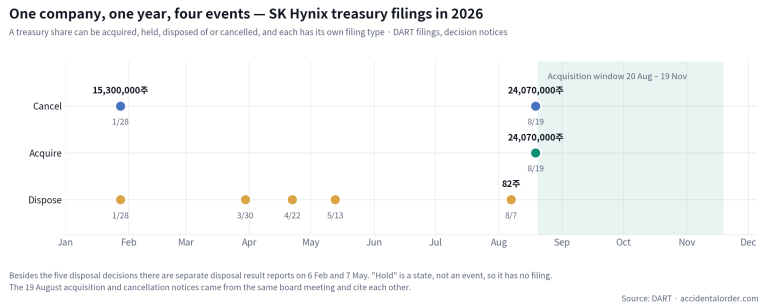
The proposition this article stakes out comes in two sentences. First, operating profit from the core business is sustained at KRW 15bn a year or more. Second, the accumulated net cash continues to be transferred to shareholders through dividends and buybacks. In fact, the cash dividend per share rose from KRW 230 in 2023 to KRW 520 in 2024 (a dividend yield of about 7% at the current price), and there have been several treasury-share disclosures over the past 24 months. If the assets are no longer merely locked in the books but have begun to flow out to shareholders, that could be the trigger that resolves the undervaluation of an asset play. This proposition is updated every quarter in stock tracking. If operating profit falls below KRW 15bn, or if returns to shareholders retreat, the proposition is discarded.
Bull Case
The backbone of the bull case is undervalued assets plus a stable core business. With cash-like assets alone exceeding market capitalisation, operating profit from the core business is being sustained at KRW 15bn a year or more. On top of that, the dividend has more than doubled, from KRW 230 per share (2023) to KRW 520 (2024), a sign that returns have begun. That the founding family holds about 50% of the shares, so that a decision to expand returns can be taken quickly, could also serve as a trigger.
① Assets larger than the market capitalisation — net cash-like assets of about KRW 374.5bn exceed the market capitalisation of KRW 214.9bn. Even valuing the core business at zero, the discount is not explained by the assets alone. ② The start of returns — the dividend increase (KRW 230 → KRW 520) and the buybacks may signal a change in a capital policy that had merely accumulated cash. ③ A stable core business — regional soju offers no rapid growth, but it generates cash steadily. The debt-to-equity ratio is a very low 19%.
Bear Case
The heart of the bear case is the quality of the cash and the limits of the core business. Because a large part of the net cash sits in marketable financial assets, valuation losses can damage net profit depending on market conditions, and results are that much less predictable. The core business, too, holds only a minor nationwide share, and with the domestic soju market itself stagnant there is limited room to grow. Above all, it is uncertain whether the accumulated cash will keep being transferred to shareholders. Whether the past record of rights issues conflicts with a returns-friendly stance needs checking, and if returns retreat the undervaluation could be left unresolved for a long time.
① The quality of the net cash — because a large part of the assets are marketable financial assets, in a falling market net profit and asset value are damaged together. The “cash-rich” narrative wobbles with market conditions. ② Structural stagnation in the core business — a rebound in regional soju’s nationwide share is not easy, and the soju market itself is not growing. ③ The durability of returns — with the founding family’s stake firmly held (Choi Jae-ho on 34.78%, the family in total about 50%), nothing compels an expansion of shareholder returns. Whether the record of rights issues over the past 24 months conflicts with the returns narrative also needs checking.
Quarterly checkpoints
| When to check | What to check | Condition for the proposition to hold |
|---|---|---|
| 2026-08 (Q2) | Core operating profit | H1 operating profit annualised at KRW 15bn+ maintained |
| Every quarter | Dividends and buybacks | No reduction in the scale of returns |
| Every quarter | Financial asset valuation gains and losses | Separating the cause of net profit swings (core business vs financial) |
What to watch next quarter
Two things to look for in the August half-year report (banyeon bogoseo, filed within 45 days of the H1 close), covering Q2 results. ① Whether core operating profit holds an annualised pace of KRW 15bn. ② Whether the flow of dividends and buybacks continues. These two are the key variables in this company’s scenario. Once the results are out, this article and stock tracking will be updated.
Sources and notices
Financial figures were taken from DART electronic disclosures (Muhak 2024 annual report, consolidated basis). The share price and market capitalisation are based on the closing price of 2026-07-10 and will move after publication. This article is for information purposes and is not a recommendation to buy or sell any particular stock.
Update log
- 2026-08-15 — FY2026 half-year update — The FY2026 half-year report was filed on 14 August 2026 (receipt 20260814001992). Its financial statements have not yet appeared in the DART financial API — neither the full nor the summary endpoint returns data, on either a consolidated or a separate basis — so no half-year figures are recorded in this update. Nothing has been substituted for them; the reading against the threshold (half-year operating profit on an annualised 15bn KRW+ footing · no reduction in dividends or buybacks) will be added to this log once the data appears. Status: awaiting data. → the half-year report · Stock Tracking
- 2026-08-15 — Each company covered here now has its own filing-traceable data page: price-to-book against total equity and against the owners’ share, five years of revenue, profit, equity and net cash, and the dividend, treasury and cancellation record — every figure beside the DART receipt it was read from. → Muhak (033920)
Get the next quarterly update for this company by email
When the next results are filed we send where this scenario stands. Nothing else.