SCD (042110): More Cash Than Market Cap — When Does That Money Become the Shareholders’?
📈 Series: Company Analysis — a series that takes listed companies apart one at a time. See the full list
※ Prices and market capitalisation as of 2026-07-16. Financial figures are cited from DART filings (consolidated basis) with sources given. DART is Korea’s mandatory electronic disclosure system.
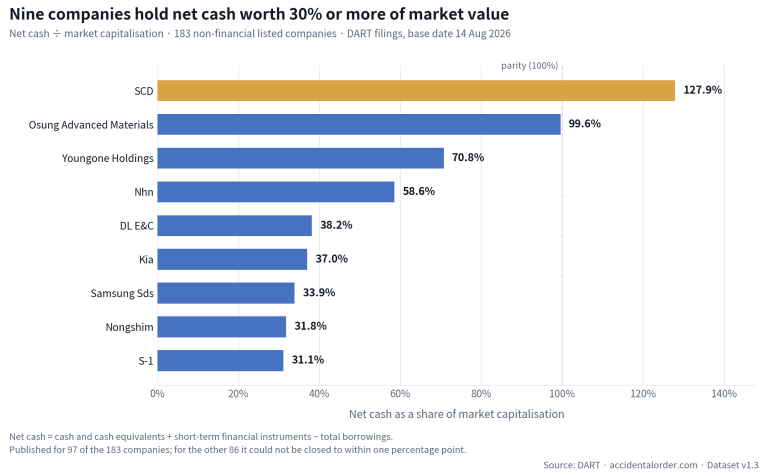
The cash in this company’s vault costs more than the whole company. SCD, listed on KOSDAQ (Korea’s growth-company market), held cash and cash equivalents of KRW 73.7bn (consolidated, end-Q1 2026), against a market capitalisation of about KRW 63.1bn (2026-07-16 close of KRW 1,306 × 48,329,564 shares). Borrowings are zero — the only liabilities are operating items such as trade payables plus KRW 220m of lease liabilities. In other words, the cash the company holds exceeds, by more than KRW 10bn, what it would cost to buy every share of it in the market.
Step motors that drive refrigerator dispensers, washing-machine drive components, motors that swing the airflow direction on air conditioners — SCD has been making the small motors that go inside home appliances for 45 years. There is no dazzling growth story. Revenue crawls sideways around KRW 200bn, and the operating margin oscillates between 3% and 5%. And yet cash has piled up for five straight years until it exceeded market capitalisation, the dividend has risen three years running, and the largest shareholder is Japan’s motor major, the NIDEC group.
This article puts the classic question of the asset play. “When, and how, does that cash become the shareholders’?” And it converts that question into verifiable numerical thresholds, to be updated quarterly starting with the August half-year report (banyeon bogoseo, filed within 45 days of the H1 close).
How it makes money — the small motors inside appliances
Here is the composition of 2025 consolidated revenue of KRW 216.1bn (DART 2025 annual report, “II. The Business”).
| Product | Application | Revenue (KRW bn) |
|---|---|---|
| UT (appliance components) | Washing-machine drives etc. | 119.9 |
| BLDC motors | Air-conditioner louvres, air-purifier drums etc. | 52.6 |
| SM (step motors) | Refrigerator dispensers, boiler valves etc. | 4.4 |
| Other products, merchandise and rental income | — | 39.2 |
The annual report is specific about what the motors do. Step motors drive refrigerator ice dispensers and boiler valves; condenser motors drive air-conditioner louvres (the airflow vanes) and the rotation of CCTV cameras; geared motors turn microwave turntables and air-purifier drums. Components that get sold a few at a time inside every refrigerator, washing machine and air conditioner sold — a business that tracks end demand for the finished appliance directly.
Production is handled by two Chinese subsidiaries, SCD (Hong Kong) and SCD (Guangzhou), which ran 260 operating days in 2025, averaging 21.6 days a month — normal operation. There is one peculiarity in revenue recognition: transactions in which raw materials are supplied on a paid basis by the customer are accounted for net, stripped out of both revenue and cost of sales. Which is to say the KRW 216.1bn of revenue on the books contains little inflation. Receivables are collected 30 to 90 days after delivery, and costs turn on the prices of raw materials such as injection mouldings, pressed parts and magnet wire, and on exchange rates. The company previously set up a Vietnamese subsidiary (SCDV) and liquidated it in 2023, so the production base is now consolidated in China alone.
The controlling shareholder is Nidec — 51.42%
There is one fact you cannot leave out when reading this company. Its largest shareholder is NIDEC INSTRUMENTS CORPORATION, with a 51.42% stake (as at end-2025). Nidec Instruments is a wholly owned subsidiary of Japan’s NIDEC CORPORATION, the world’s largest small-motor company. It became the largest shareholder in 2012 by acquiring the stake from the private equity firm Skylake (under its then name, NIDEC SANKYO), and has held a majority stake for the 14 years since.
The fact that the majority shareholder is a global motor company cuts both ways. On one hand there is the group’s umbrella in technology, customers and procurement, and for 14 years the company has been run without dilution of minority shareholders through rights issues or convertible bonds. On the other hand, the key to deciding what happens to the company’s KRW 73.7bn of cash — pay it out as dividends, invest it in line with group strategy, or simply let it accumulate — effectively sits with Nidec. Which means the asset-play proposition succeeds or fails on the controlling shareholder’s capital-allocation intent, and that is why this article takes the dividend as its assessment metric.
Five years of numbers — thin manufacturing at a 2–5% margin

| Consolidated (KRW bn) | 2021 | 2022 | 2023 | 2024 | 2025 |
|---|---|---|---|---|---|
| Revenue | 202.2 | 218.9 | 194.0 | 214.0 | 216.1 |
| Operating profit | 9.12 | 11.33 | 5.75 | 9.34 | 6.31 |
| Net profit | 6.93 | 8.30 | 4.84 | 8.39 | 6.40 |
| Operating margin | 4.5% | 5.2% | 3.0% | 4.4% | 2.9% |
| EPS (KRW) | 143 | 172 | 100 | 174 | 132 |
Source: DART fnlttSinglAcntAll (corp 00171867, annual report 11011, consolidated)
Revenue crawls sideways around KRW 200bn, and operating profit moves up and down between KRW 6bn and KRW 11bn. When end demand for appliances turns down, as in 2023, profit halves (KRW 5.75bn); when it recovers, as in 2024, it returns to the KRW 9bn range — a pattern now in its fifth year of profit swinging with the cycle without ever tipping into a loss. This is not a growth company; it is one where you watch whether the profits dry up. And through those swings the dividend has been paid every year, and over the last three years it has actually risen.
The pressure point — KRW 73.7bn of cash, KRW 63.1bn of market cap, zero debt

Year-end cash and cash equivalents have piled up for five straight years: KRW 49.1bn (2021) → 58.1bn → 61.7bn → 67.9bn → 70.0bn (2025) → 73.7bn (Q1 2026). The mechanism behind cash growing despite thin margins is simple. Operating cash flow comes in steadily (KRW 5.91bn in 2025, and KRW 5.10bn even in Q1 2026), investment stays at maintenance level (investing activities of KRW −2.51bn in 2025), and the money going out as dividends (KRW 1.7–2.4bn a year) is smaller than the money coming in. Total equity is KRW 136.8bn — market capitalisation (KRW 63.1bn) is 46% of that (PBR of 0.46x).
Do the arithmetic and the meaning of this price becomes vivid. Subtract cash of KRW 73.7bn from a market capitalisation of KRW 63.1bn and the market is assigning a value of minus KRW 10.6bn to a business with annual revenue of KRW 216.1bn and operating profit of KRW 6.31bn. There is a trap in that arithmetic, of course. Cash sitting in the company vault and cash placed in shareholders’ hands are two different things. At a company with a majority shareholder, the only real conduit through which minority shareholders reach that cash is the dividend. So the dividend is the yardstick for measuring this gap.
The dividend — KRW 30 → 35 → 50
| Fiscal year | Dividend per share | Total dividends (KRW bn) | Consolidated payout ratio | Dividend yield |
|---|---|---|---|---|
| 2023 | KRW 30 | 1.45 | 30% | 1.7% |
| 2024 | KRW 35 | 1.69 | 20% | 2.5% |
| 2025 | KRW 50 | 2.42 | 38% | 3.8% |
Source: DART 2025 annual report, section on dividends
Three consecutive increases, and the rate of increase is steep (+17%, +43%). In April 2026 the company filed a corporate value enhancement plan (voluntary disclosure) that explicitly committed to “setting an appropriate level of dividend with shareholder value in mind” along with margin improvement and market diversification (filing 20260420900501). It is unusual for a small KOSDAQ company to go as far as a voluntary value-up disclosure, so the controlling shareholder side has effectively put the direction of expanding shareholder returns in writing. Over the last 24 months there have been no dilutive disclosures such as rights issues, convertible bonds or disposals of treasury shares.
What remains is a question of speed. At KRW 2.4bn of dividends a year, it would take 30 years for KRW 73.7bn of cash to reach shareholders. Continuation of the upward dividend trend is the minimum condition for the signal that “the cash is flowing to shareholders.”
But — the warning in the first quarter of 2026
The premise of the asset-play proposition is that the core business keeps generating cash. A signal has appeared that cracks that premise. Q1 2026 revenue was KRW 51.0bn (−14.3% yoy) and operating profit KRW 510m (−81.7%) (quarterly report, 2026-05-15).
| Q1 25 | Q2 25 | Q3 25 | Q4 25 | Q1 26 | |
|---|---|---|---|---|---|
| Revenue (KRW bn) | 59.5 | 52.4 | 53.1 | 51.1 | 51.0 |
| Operating profit (KRW bn) | 2.78 | 1.63 | 1.31 | 0.59 | 0.51 |
Source: DART quarterly and half-year reports (consolidated)
Quarterly operating profit has declined for five consecutive quarters. From KRW 2.78bn down to KRW 510m — still positive, but the layer of profit has thinned to a fifth of what it was. The company already flagged the earnings decline in its 2025 accounts with a “change of 30% or more in revenue or profit structure” disclosure (2026-01-26), and the trend has not turned in 2026 either. If raw material and currency pressure piles on top of weak appliance end demand, the next step is a quarterly loss. Whether the company crosses that line is the biggest watch point in this half-year report.
One cushion is cash flow. Even in the quarter when profit thinned to KRW 510m, operating cash flow came in at KRW +5.10bn, and cash and equivalents actually rose from KRW 70.0bn to KRW 73.7bn. This is the classic pattern of working capital unwinding and releasing cash during an earnings trough in manufacturing, but it does not offset the earnings trough itself.

The share price has fallen over the long run from its 2021–22 peak (in the KRW 3,000s) to around KRW 1,300. The 52-week range is KRW 1,024–1,601. Market capitalisation dropping below the cash balance, and the dividend yield rising to 3.8%, are both products of that decline. Turn it around and this stock’s price chart is the record of what the market has been willing to pay for “manufacturing whose profits are thinning,” while cash and dividends, the counterweight on the other side of the scale, have yet to exert any force on the chart.
The new business — automotive parts as an option
The “company overview” section of the annual report names the manufacture and sale of automotive parts as a new business to be pursued. It is an adjacent extension of the company’s motor technology, and it is a plausible direction given that the controlling Nidec group is strong in automotive motors, but nothing has been booked as revenue to date and there are no specific order or investment disclosures. I do not include it in this article’s core scenario, but I do set as a secondary watch point whether automotive-parts revenue appears for the first time in “The Business” section of the half-year and third-quarter reports. There is a caveat too — if the new business leads to large-scale capital expenditure, dividend capacity and cash could shrink, which could put it in tension with the asset-play proposition.
Core scenario — net cash > market cap, and continuation of the dividend
The proposition this article verifies each quarter is a single one. The threshold numbers are set in advance and are not moved afterwards.
“A debt-free company holding KRW 73.7bn of cash (against a market capitalisation of KRW 63.1bn) keeps its core business profitable while continuing to raise the dividend (KRW 30 → 35 → 50) — does the signal that ‘cash is flowing to shareholders’ hold?”
- Numerical threshold ①: H1 2026 cumulative operating profit stays positive — not letting the trend from Q1’s KRW 510m tip into a quarterly loss is the premise for a profitable full year
- Numerical threshold ②: dividend per share of KRW 50 or more for the 2026 fiscal year — the upward trend maintained, or at minimum no retreat
- Numerical threshold ③: cash and equivalents of KRW 70bn or more and debt-free status maintained — the floor under asset value does not move
- Falsification conditions: consecutive operating losses in Q2 and Q3 leading to a full-year loss; a dividend cut; or a sharp fall in cash from large-scale investment with no visible payback — any one of the three rejects the proposition
- Confirming data: the half-year report in mid-August (filed 14 Aug last year) → the dividend resolution disclosure next February (26 Feb last year)
The bull case
① A safety net in the price. Market capitalisation of KRW 63.1bn < cash of KRW 73.7bn, zero borrowings, PBR of 0.46x. Value the business at zero and the cash still covers the market cap. To lose a lot more from this price, the cash itself would have to be impaired.
② The direction of the dividend, and a documented intent. Three consecutive increases (KRW 30 → 35 → 50), a 3.8% yield. The dividend policy has been formalised in a voluntary value-up disclosure. Because the controlling shareholder holds a majority, the largest beneficiary of the dividend is the controlling shareholder itself — the incentives on expanding the dividend are aligned.
③ The momentum of cash generation. Operating cash flow stayed positive even in the thin-margin years, and cash has grown five years running. Even in Q1 2026, when profit thinned to KRW 510m, operating cash flow was KRW +5.10bn and cash rose KRW +3.7bn.
④ Absence of dilution risk. In 14 years under Nidec there have been no rights-issue or convertible-bond disclosures and the share count is unchanged. It is a structure in which per-share value quietly accumulates, and with market capitalisation more than double the delisting market-cap standard (KOSDAQ KRW 30bn from 2027), it also stands at a distance from regulatory risk.
The bear case
① Rapid erosion of profit. Quarterly operating profit has fallen for five consecutive quarters, down to KRW 510m. The next step is a loss. Slide into a full-year loss and the premise of the “core business profitable + dividend” proposition collapses, and the dividend increases lose their basis too.
② A vault far larger than the dividend, and the controlling shareholder’s key. At KRW 2.4bn a year it takes 30 years for KRW 73.7bn to reach shareholders. The decision on dividends, investment and retention rests with Nidec and its 51.42% stake, and minority shareholders have essentially no means of changing capital allocation. It is a structure in which “the reason it is cheap” can persist unresolved for a long time.
③ Dependence on a single end market. Most of the revenue comes from components for one end market (refrigerators, washing machines, air conditioners), leaving no way to escape weak end demand. There are also cost, currency and geopolitical variables around a single production base in China.
④ The new business is empty, and cuts both ways. Automotive parts is still at the declaration stage with zero revenue. If it is slow to materialise it becomes a bad cheque rather than a growth option; and if it does materialise through large-scale investment, it could eat into dividend capacity.
Next quarter’s watch points (August 2026)
| When | What to check | Condition to hold |
|---|---|---|
| Mid-August (half-year report, 14 Aug last year) | Q2 operating profit | Quarterly profit stays positive (H1 cumulative positive) |
| Mid-August (half-year report) | Cash and equivalents, borrowings | Cash KRW 70bn+ · debt-free status maintained |
| Mid-August (half-year report) | “The Business” — automotive parts | Whether revenue is booked for the first time (secondary indicator) |
| February next year (dividend disclosure, 26 Feb last year) | Dividend per share for FY2026 | KRW 50 or more |
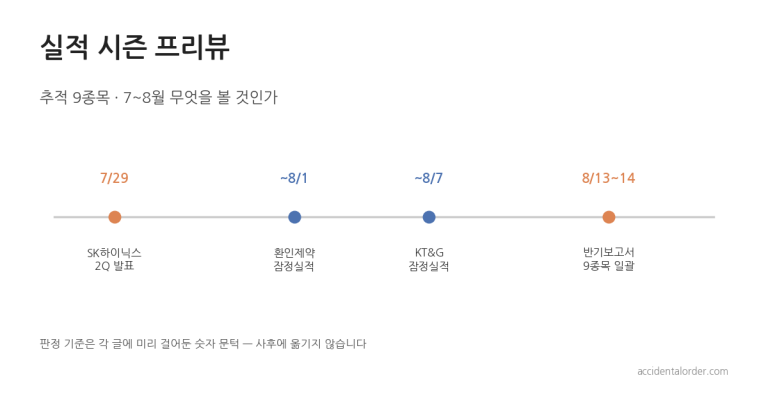
The outcome will be reflected on the tracking ledger. The initial listed status is ⚪ (first update pending). The full schedule for this season is set out in the earnings season preview.
The three traps of asset plays — applied to SCD
A stock with more cash than market capitalisation looks free at first glance, but there are recurring reasons why such stocks are left cheap for a long time. Let me apply those three traps to SCD one at a time.
Trap ① the value trap — cheap, and cheap forever. Without a catalyst, the discount never closes. SCD’s candidate catalysts are continuation of the dividend increases and execution of the value-up disclosure. There is a track record of three consecutive increases, so this is not a case of “no catalyst,” but speed is the issue. Trap ② misalignment between the controlling shareholder and minority shareholders — the cash does not come to minority shareholders but is used for the controlling shareholder’s other purposes. With a majority shareholder (Nidec at 51.42%), this risk exists structurally at SCD; conversely, because the controlling shareholder receives more than half of any dividend, the incentive to expand the dividend also sits with the controlling shareholder. The absence of dilutive financing over 14 years is a favourable circumstance. Trap ③ liquidity and regulatory risk — small caps are hard to buy and sell in the size and at the price you want, and lately a regulatory variable has been added in the form of the higher market-capitalisation requirement for continued listing. SCD’s market capitalisation (KRW 63.1bn) sits well clear of the KOSDAQ standard (currently KRW 20bn, KRW 30bn from 2027), so regulatory risk is on the low side.
In short, the weakest link in this company’s asset-play proposition lies between traps ① and ② — “does the core business stay profitable, and does the controlling shareholder keep choosing to expand the dividend?” That is why the assessment metrics are hung on results (a profitable H1) and the dividend (KRW 50+).
Three-line summary
One. A debt-free company whose cash (KRW 73.7bn) exceeds its market capitalisation (KRW 63.1bn) — the market is assigning a negative value to a business with annual revenue of KRW 216.1bn. Two. The only conduit through which that cash flows to shareholders is the dividend, and fortunately the direction is good (KRW 30 → 35 → 50, formalised in a value-up disclosure). But the decision rests with Nidec and its 51.42% stake. Three. The premise — a profitable core business — has thinned for five consecutive quarters, down to KRW 510m. Holding a quarterly profit in the August half-year report is the first assessment line, and a KRW 50 dividend next February is the second. The outcome will be recorded as it comes on the tracking ledger.
Sources and disclosure
Sources for the figures: DART electronic disclosures (annual report, quarterly report, dividend disclosure, corporate value enhancement plan, change in profit structure; corp 00171867) and KRX prices. Price reference date 2026-07-16. Figures may change after the date of writing (July 2026).
This article is for informational purposes and is not a recommendation to buy or sell any security. Target prices and trade timing are not addressed.
Related reading: Muhak analysis — net cash larger than market capitalisation · How to read the balance sheet · The traps in PER and PBR · Capital allocation
Update log
- 2026-08-15 — FY2026 half-year update — FY2026 half-year report filed — revenue KRW 98.9bn (KRW 112.0bn a year earlier), operating profit KRW 0.6bn (KRW 4.4bn a year earlier), net profit KRW 0.6bn (KRW 4.9bn a year earlier). Threshold (1), a cumulative operating profit through the half year: KRW 0.60bn against KRW 4.41bn a year earlier, so above the threshold. Threshold (2), cash of KRW 70bn+ with no borrowings: cash and cash equivalents stand at KRW 68.9bn, below the KRW 70bn line (KRW 70.0bn at the FY2025 year-end), while total borrowings remain nil, so the no-borrowings half of that threshold is held. Threshold (3), a FY2026 dividend of KRW 50+ per share, falls due with the February 2027 dividend filing and is not yet in range for this cycle. Status: mixed. → the half-year report · Stock Tracking
- 2026-08-15 — Each company covered here now has its own filing-traceable data page: price-to-book against total equity and against the owners’ share, five years of revenue, profit, equity and net cash, and the dividend, treasury and cancellation record — every figure beside the DART receipt it was read from. → SCD (042110)
Get the next quarterly update for this company by email
When the next results are filed we send where this scenario stands. Nothing else.