KG Eco Solution (151860): The 0.09x P/B Is an Illusion — Of KRW 3tn in Equity, Only KRW 1,458.9bn Belongs to Shareholders
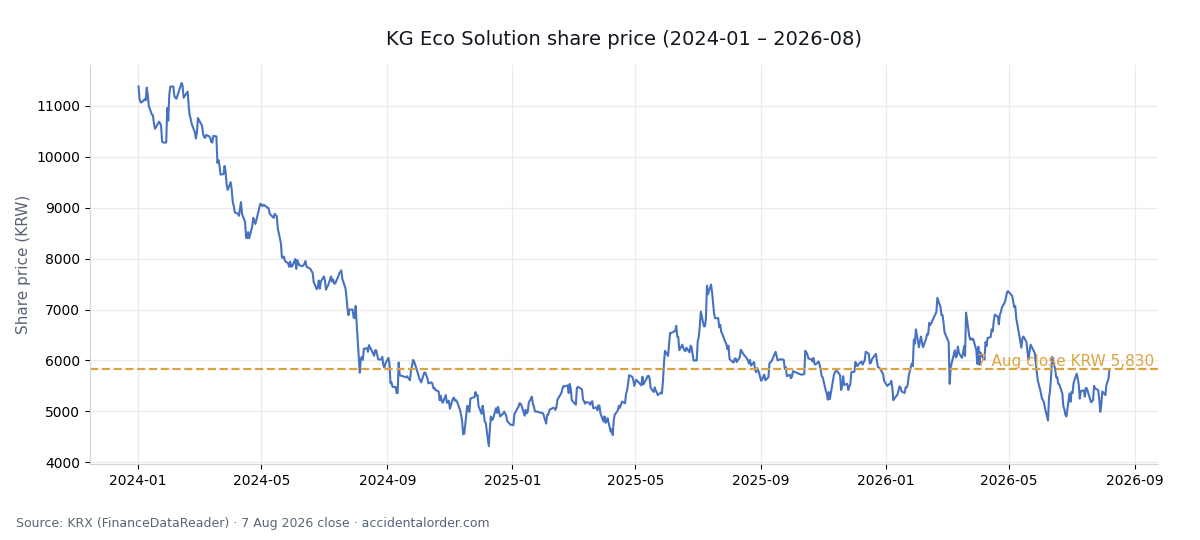
When a stock screen shows a price-to-book ratio of 0.08x, most people reach for one of two conclusions. Either the company is about to go under, or the market is missing something big. That is exactly what the numbers look like at KG Eco Solution (151860). Multiply the closing price of KRW 5,830 on 7 August 2026 by the 47,603,002 shares outstanding and you get a market capitalisation of KRW 277.5bn, while consolidated total equity at the end of Q1 2026 stood at KRW 3,164.7bn. The company trades at one eleventh of its equity.
The first thing to say in this piece, though, is that the 0.08x figure is an illusion. The numbers behind that claim come later. Before you can judge whether something is cheap or expensive, you first have to check whether that equity really belongs to shareholders.
The name says bioenergy; the substance is a conglomerate
Going by the name alone, this reads as a green energy company. And one of its core businesses genuinely is bioenergy, such as bio heavy fuel oil. Yet most of the KRW 7,577.2bn in consolidated revenue for 2025 does not come from that core business. Sitting under the consolidation are businesses such as steel (KG Steel) and finished vehicles (KG Mobility). In fact, most of the disclosures this company has filed since July 2026 are material-management filings for “the subsidiary KG Mobility Corp.” and “the subsidiary KG Steel Co., Ltd.” (Source: DART filings of 2026-07-28, 2026-07-31 and 2026-08-03)
In other words, this is not a stock where you analyse one business. It is a stock where you analyse a conglomerate with several different industries stacked on a single set of books. The largest shareholder is KG Chemical Corp. with 41.34%, and the company itself sits as an intermediate link in the KG Group ownership chain. That structure is the root of the discount discussed below.
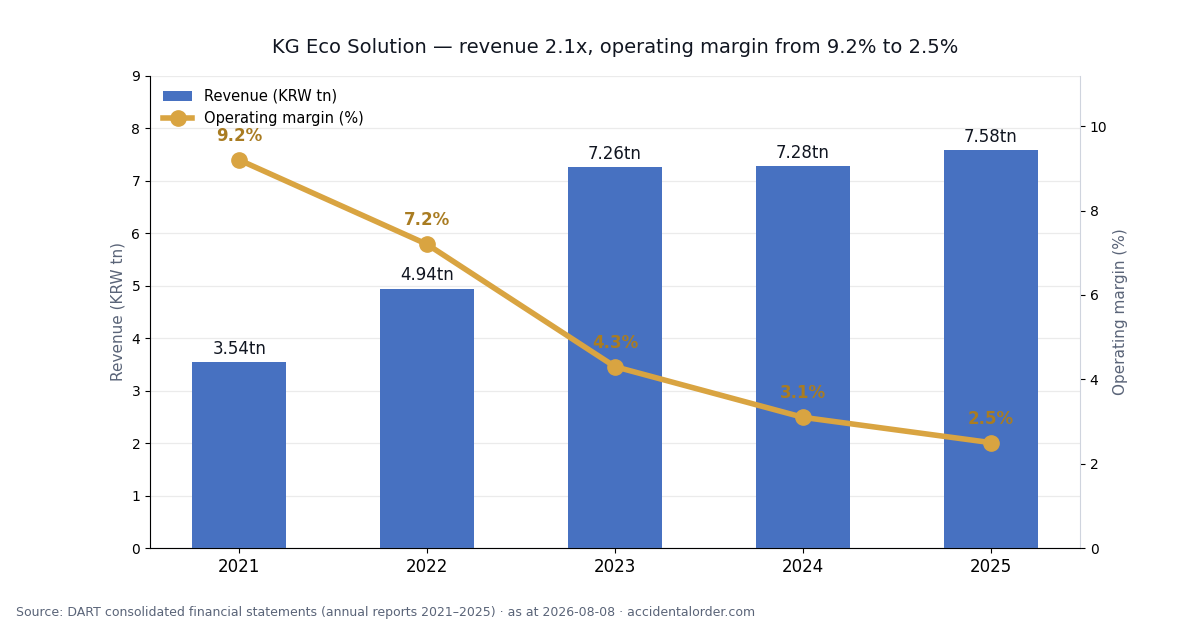
Five years — revenue up 2.1x, margin cut to less than half
| (KRW bn) | 2021 | 2022 | 2023 | 2024 | 2025 |
|---|---|---|---|---|---|
| Revenue | 3,536.9 | 4,944.2 | 7,257.2 | 7,284.9 | 7,577.2 |
| Operating profit | 325.6 | 356.2 | 309.8 | 226.5 | 191.3 |
| Net profit (total) | 192.6 | 904.9 | 219.6 | 214.2 | 183.7 |
| Operating margin | 9.2% | 7.2% | 4.3% | 3.1% | 2.5% |
Over five years revenue went from KRW 3,536.9bn to KRW 7,577.2bn, or 2.1x. On the top line alone, this is a growth company. Over the same period, however, operating profit fell from KRW 325.6bn to KRW 191.3bn, and the operating margin sank from 9.2% to 2.5%. The company sells twice as much and keeps less money than before.
The simple fact that the margin has fallen five years running is this company’s first weak point. When steel market conditions are depressed, revenue holds up while margins get shaved, and the shape of the table is exactly that. What matters is whether that decline has passed its floor, and the answer will only come from the next quarter’s numbers.
Q1 2026 was more depressed still
Consolidated revenue in Q1 2026 was KRW 1,969.6bn and operating profit was KRW 32.8bn. Against KRW 75.4bn in the same quarter a year earlier, that is −56.5%. Expressed as a margin, it works out at roughly 1.7%. Which means the margin that has been sliding for five years has yet to show a sign of turning. (Source: DART Q1 2026 quarterly report, consolidated)
So, the 0.08x P/B is an illusion
This is the heart of the piece. Consolidated total equity at the end of Q1 2026 really was KRW 3,164.7bn. But split that equity by whom it belongs to, and it breaks down like this.
| End of Q1 2026 (KRW bn) | Amount | Share |
|---|---|---|
| Controlling-interest equity | 1,458.9 | 46% |
| Non-controlling interests | 1,705.8 | 54% |
| Total equity | 3,164.7 | 100% |
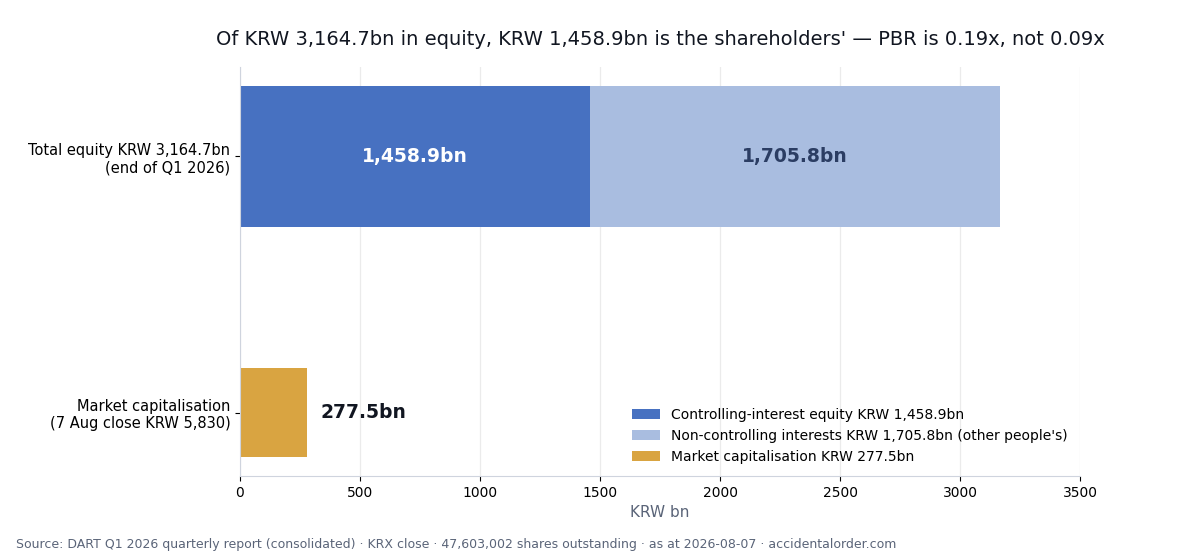
KRW 1,705.8bn, or 54% of consolidated equity, is non-controlling interests. Put simply, that is the portion of the subsidiaries’ equity that does not belong to this company’s shareholders. It exists because the group does not own the conglomerate’s units outright but holds only part of them while still consolidating them in full. That money is on the books, but it is not a claim KG Eco Solution shareholders can make.
Recalculate the multiples on the shareholders’ share and they change.
| Metric | On total equity | On controlling-interest equity |
|---|---|---|
| P/B | 0.09x | 0.19x |
| Equity base | KRW 3,164.7bn | KRW 1,458.9bn |
The same goes for earnings. Of the KRW 183.7bn in consolidated net profit for 2025, KRW 82.4bn was attributable to controlling interests and the remaining KRW 101.3bn to non-controlling interests. Computed on the shareholders’ share of earnings, the P/E is roughly 3.4x. (Source: DART 2025 annual report, consolidated)
0.19x and 3.4x are still low numbers. The stock is still on the cheap side. But “it trades at one tenth of its assets” and “it trades at one fifth of the assets that belong to shareholders” are two different statements. That is precisely why reading consolidated financial statements calls for the habit of separating controlling-interest equity from non-controlling interests, and the gap that habit reveals is widest at holding companies and conglomerates. (→ consolidated vs separate financial statements)
The question that remains — why doesn’t this discount unwind?
Even 0.19x on the shareholders’ share is low. If the company were dying, that would explain it, but it still earned KRW 191.3bn in operating profit in 2025 and net profit was positive too. So the reason for the discount lies not in the results but in the structure.
First, there is the conglomerate discount. When steel, finished vehicles and bioenergy are mixed on one set of books, the company does not fit neatly into any analyst’s coverage. Second, there is the governance discount. Because the company is an intermediate link in the group’s control chain, it invites the suspicion that the needs of the wider group may come before the value of this company’s own shareholders. Third, the margin has fallen five years in a row.
The disclosures clustered in the past two weeks — the other side of an unwinding discount
Anyone looking at this stock now has to read the filings made since the end of July alongside the financials, because within two weeks a run of funding decisions came out of the group. All of them were filed as “material management matters of a subsidiary”.
| Date | Item | Amount |
|---|---|---|
| 2026-07-28 | Increase in short-term borrowings at the subsidiary KG Mobility — foreign-currency short-term borrowing (USD 75mn) to pay technology licence fees to Chery Automobile (CHERY) | KRW 109.9bn |
| 2026-07-31 | Provision of collateral for a third party by the subsidiary KG Steel — 19,225,720 common shares of K Car Co., Ltd. pledged as joint collateral for acquisition financing | Collateral set at KRW 137.5bn |
| 2026-08-03 | Issuance by the subsidiary KG Mobility of its 124th unguaranteed privately placed convertible bond (coupon 0.0%, yield to maturity 1.0%, maturing 2029-08-11, for working capital) | KRW 108.1bn |
With that decision, KG Mobility’s total short-term borrowings rose from KRW 281.4bn to KRW 391.3bn. The collateral provided by KG Steel amounts to 6.7% of its equity, and the debtors include what appears to be an affiliate, K Mobility Value-up Corp., with KRW 55.0bn, within a joint collateral package totalling KRW 155.0bn.
None of this means the disclosures themselves are bad news. Borrowing is a normal way to run a business, and so are convertible bonds. What matters is the direction. For the discount to unwind, capital has to flow toward shareholders, yet the flow of the past two weeks has been toward tying funds up within the group. That is all the more true given that short-term borrowings had already risen as of Q1 2026 (short-term KRW 1,005.5bn, long-term KRW 249.4bn, cash KRW 218.6bn).
The company disclosed that it would hold an investor relations (IR) briefing on 6 August 2026. That is the venue where the items above should be explained.
Treasury shares of 11.9% and the dividend
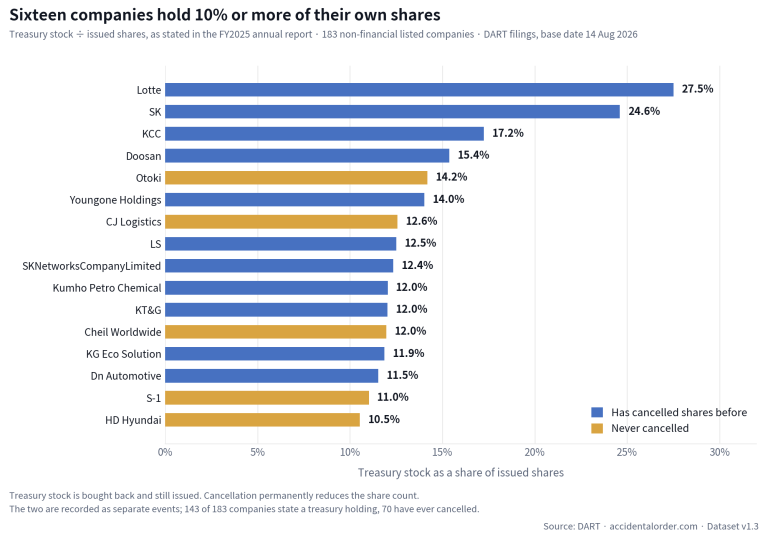
There is one lever sitting at this company that could unwind the discount: 5,646,903 treasury shares, or 11.9% of shares outstanding. Cancel that block and per-share value rises immediately. Dispose of it to an affiliate instead and it serves to reinforce control while doing nothing for shareholder value. The same asset works in opposite directions depending on which way it is used.
The dividend has risen from KRW 120 per share (2023) to KRW 120 (2024) to KRW 150 (2025). On the 7 August closing price the dividend yield is about 2.6%, and the payout ratio stays in the 3% range. Relative to the profits earned, that is still stingy, and it is exactly that headroom that makes the next act worth watching.
Bull and Bear
Bull — seen this way, it is attractive
Controlling-interest equity of KRW 1,458.9bn against a market capitalisation of KRW 277.5bn. On earnings attributable to shareholders of KRW 82.4bn, that is a P/E of 3.4x and a P/S of roughly 0.04x. This is not a loss-making company; it makes a profit every year and sits at these multiples. On top of that, treasury shares of 11.9% are a card that can be played immediately, and the dividend has turned back to a rising trend after three years. Should steel market conditions turn and the margin merely recover from 2.5%, the absolute level of profit would move sharply.
Bear — seen this way, it is a trap
The operating margin has fallen five years running (9.2% → 2.5%) and did not rebound in Q1 2026. Borrowings stand at around KRW 1,254.9bn, and in the past two weeks group borrowings and collateral have grown further. Above all, this is a discount that has persisted for years. Cheap things are cheap for a reason, and if that reason is governance, the situation can go on for years without a catalyst for the market to reprice it. (→ the value trap)
The core scenario we are backing, and its numerical thresholds
So the scenario we attach to this stock is not “it is cheap”. That it is cheap is already known, and it has stayed that way for years. What we are tracking is whether a signal that the discount is unwinding actually appears.
Core scenario — the discount unwinds. If the reason the P/B is low is a governance and conglomerate discount, then unwinding that discount also has to be the company’s decision. Does a signal appear in the form of cancelling the 11.9% treasury stake or expanding shareholder returns?
| Category | Detail |
|---|---|
| Threshold (clear this and the scenario is on track) | A disclosure of treasury share cancellation, or the dividend per share for the 2026 financial year raised to KRW 200 or more |
| Disconfirmation (this means the scenario is off track) | Disposal of treasury shares to an affiliate, or further expansion of group-support transactions (borrowings, collateral, loans of funds) |
| Point of confirmation | Ad hoc disclosures (ongoing) plus the year-end dividend disclosure in March 2027 |
What deserves careful attention is that signals on the disconfirming side of this scenario have already accumulated over the past two weeks. The borrowing on 28 July, the collateral on 31 July and the convertible bond on 3 August are all related to group funding. There has been no disposal of treasury shares yet, so we are not recording the scenario as off track, but whether this direction continues is the first item to check at the next update.
What to watch next quarter
① Has the margin passed its floor? — whether cumulative H1 2026 operating profit exceeds the year-earlier first half (about KRW 48.3bn). We will check this in the half-year report (banyeon bogoseo, filed within 45 days of the H1 close) in mid-August.
② The direction of group funding flows — whether a disclosure of treasury share disposal appears, and whether group borrowings and collateral grow further. We will check this through ad hoc disclosures.
③ Signals on shareholder returns — whether any mention of treasury share cancellation or a change in dividend policy follows the investor briefing on 6 August.
These three are the first items we will check when we update this piece next quarter. The status is recorded in the stock tracking ledger, and even if a scenario goes off track we leave that record in place rather than deleting it.
Summing up
KG Eco Solution is a stock you discover through the surface number “P/B of 0.08x”, but once you establish that more than half of that number is non-controlling interests, the story changes. A P/B of 0.19x and a P/E of 3.4x, calculated on the shareholders’ share, are the real starting point. Those multiples are clearly low too, and the lever of an 11.9% treasury stake genuinely exists.
But a low multiple does not by itself become a return. A decision that unwinds the discount has to come, and the disclosures of the past two weeks still point the other way. So instead of guessing at a price, we set numerical thresholds and update the status every quarter.
This article does not recommend buying or selling any particular stock, and does not present target prices or trading timing. All figures are based on DART electronic disclosures and KRX data, as of 7 August 2026 (share price) and the Q1 2026 quarterly report (financials). For details, please see the disclaimer.
Update log
- 2026-08-15 — Each company covered here now has its own filing-traceable data page: price-to-book against total equity and against the owners’ share, five years of revenue, profit, equity and net cash, and the dividend, treasury and cancellation record — every figure beside the DART receipt it was read from. → KG Eco Solution (151860)
- 2026-08-14 — The calculation in this article (reading P/B against total equity and against the owners’ share separately) has been extended to 183 companies. KG Eco Solution ranks seventh by gap in that dataset, at +117.7%. → The Owner’s Share: P/B for 183 Korean Companies, Recalculated from the Filings · Adjusted valuation table · Data room
Get the next quarterly update for this company by email
When the next results are filed we send where this scenario stands. Nothing else.