KT&G (033780): The Report Card Overseas Rewrote
This is a stock analysis that takes listed companies apart one at a time. It is not a recommendation to buy or sell any particular stock, and all figures are as of the time of writing (July 2026) and may change thereafter.
Core scenario: overseas cigarette revenue keeps growing at a rate above 20% — this reasoning is updated every quarter in stock tracking.
The stock taken apart in this piece is KT&G. There are three reasons for choosing it. First, its business structure is simple, which makes it good for demonstrating an analytical framework — it sells tobacco to generate cash, then allocates that cash to dividends and new businesses. Second, the story of this company is changing right now: in 2025, for the first time ever, overseas overtook domestic in the cigarette revenue of a company that had been called a “defensive domestic-demand stock” for decades. Third, it is a specimen that shows how a “boring company” should be read. This is territory that uses different muscles from growth-stock analysis.
The structure of this article is also the framework that recurs in stock analysis — how the company makes money → the recent numbers → bull case → bear case → valuation frame → quarterly checkpoints. We will go through them in order.
Company snapshot
| Item | Detail |
|---|---|
| Stock | KT&G (KRX 033780) |
| Business mix | Tobacco (domestic and overseas cigarettes, NGP) + health functional foods (Jung Kwan Jang) + property |
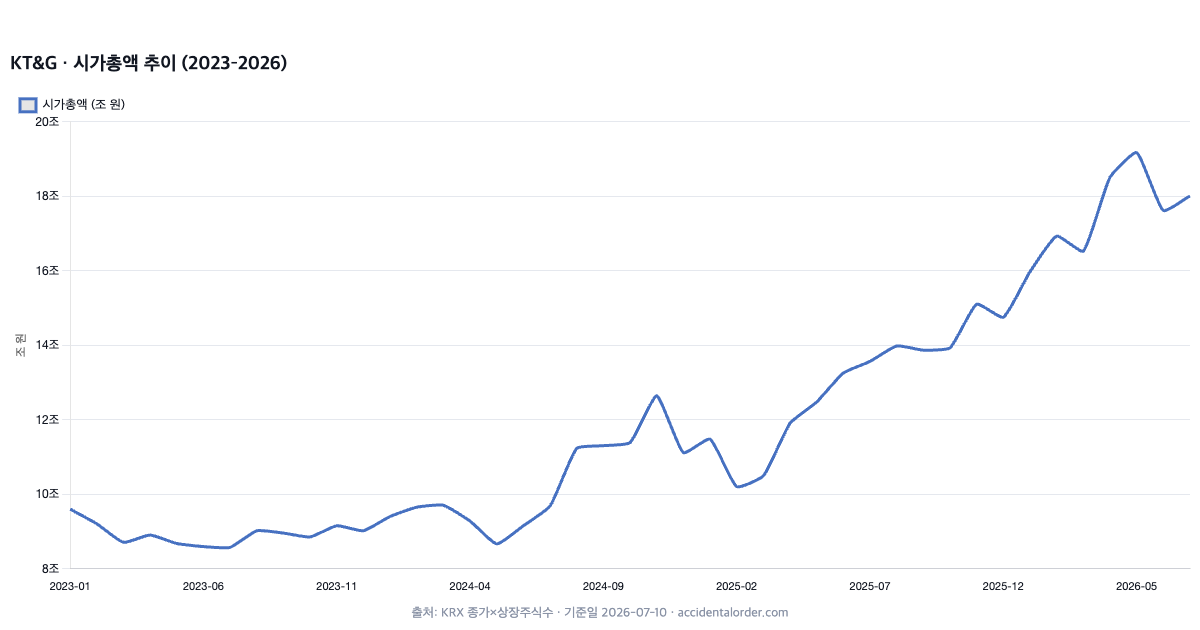
| Share price / market capitalisation | Approx. KRW 185,600 / approx. KRW 17.9tn (early July 2026) |
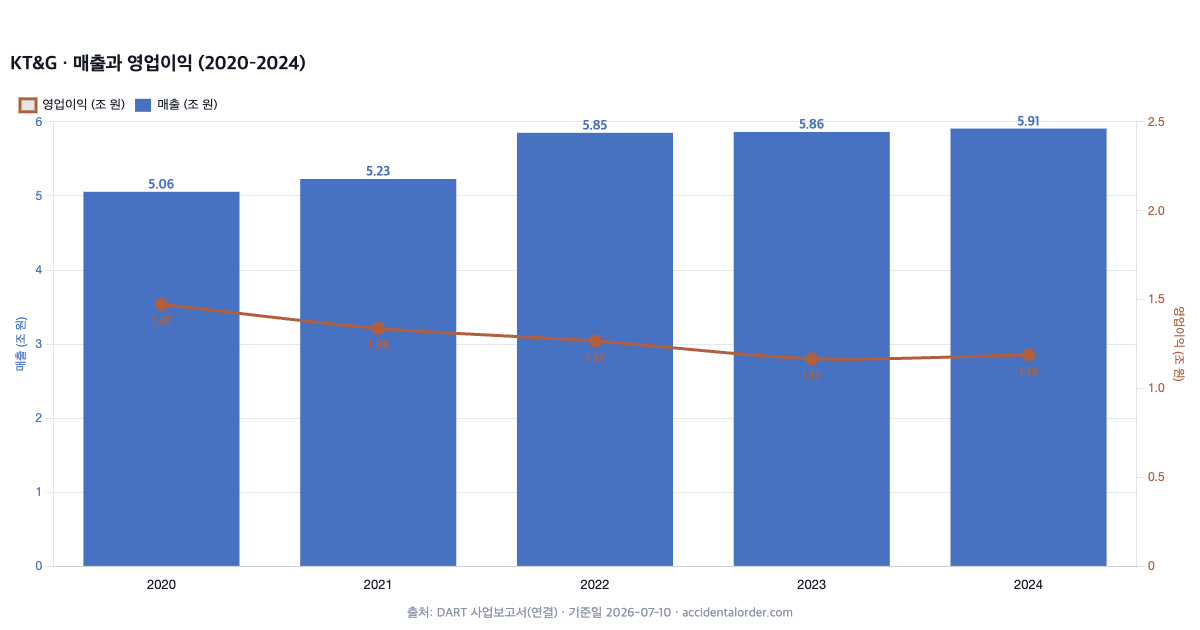
| FY2025 results (consolidated) | Revenue KRW 6,579.6bn (+11.4%), operating profit KRW 1,349.6bn (+13.5%) |
| Adjusted operating profit | KRW 1,419.8bn (+19.4%) — excluding approx. KRW 70bn of one-off labour costs |
| Shareholder returns | Dividend increase announced to around KRW 6,000 per share, alongside buybacks and cancellation of treasury shares |
| 2026 guidance | Revenue +3–5%, operating profit +6–8% |
What to watch next quarter
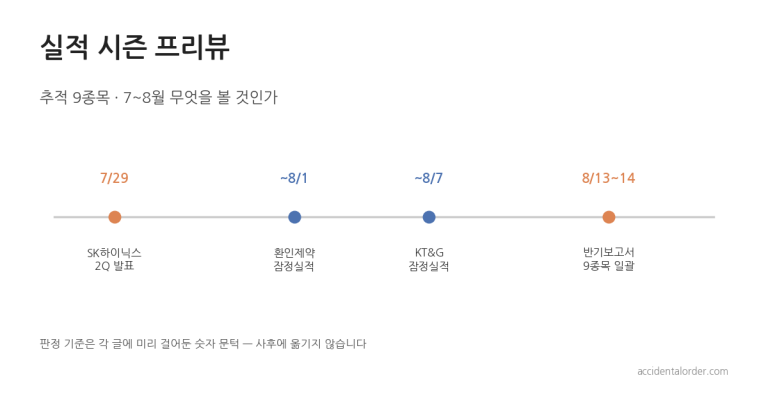
There are two things to look for in the August half-year report (banyeon bogoseo, filed within 45 days of the H1 close) covering Q2 results. ① Whether overseas cigarette (stick) revenue keeps growing at a rate above 20%. ② Whether Jung Kwan Jang’s China revenue shows a recovery. These two are the core variables of this stock’s scenario. Once the results are out we will update this article and stock tracking.
1. How the company makes money
KT&G’s profit and loss is built on three pillars. The first pillar, and the body of the business, is tobacco. It holds an overwhelming number one share of the domestic cigarette market, and attached to that are two growth vectors — cigarette exports reaching into the Middle East, Central Asia and Southeast Asia, and the heated-tobacco product (NGP) “lil”. A structural feature is that lil’s overseas sales run through a partnership with Philip Morris International (PMI): instead of building its own distribution network, KT&G borrows the network of the world’s largest tobacco company, which leaves any change in the terms of that arrangement as a risk.
The second pillar is health functional foods — Jung Kwan Jang, run by the subsidiary Korea Ginseng Corporation. As the leading brand in Korea’s red ginseng market, it is sensitive to overseas consumption centred on China. The third pillar is property — the development of land held across the country (former tobacco-manufacturing plants and the like), whose profit contribution is intermittent but which acts as a reservoir of asset value. In short: tobacco makes the cash, and the rest are the places that cash is allocated to, and the options it buys.
2. The FY2025 numbers: what revenue above KRW 6tn means
| Item | FY2025 | Year on year |
|---|---|---|
| Consolidated revenue | KRW 6,579.6bn | +11.4% |
| Operating profit | KRW 1,349.6bn | +13.5% |
| Adjusted operating profit (ex one-offs) | KRW 1,419.8bn | +19.4% |
| Q4 revenue | KRW 1,713.7bn | +10.1% |
| Q4 operating profit | KRW 248.8bn | +17.1% |
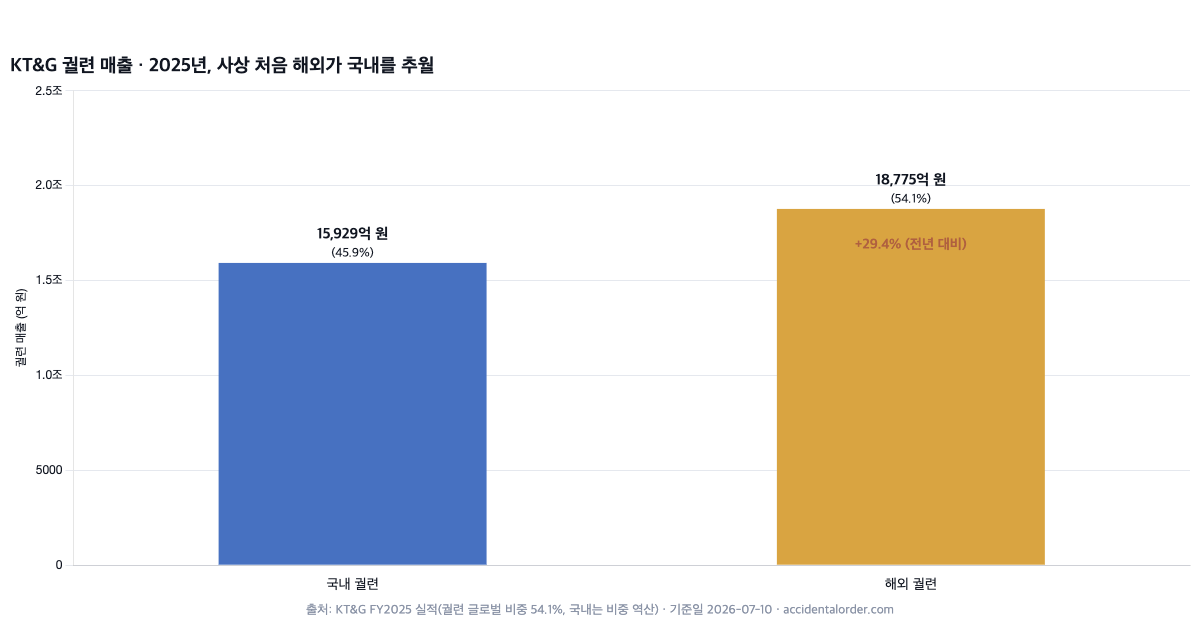
| Overseas cigarette revenue | KRW 1,877.5bn | +29.4% |
The heart of these numbers is the last line. Overseas cigarettes grew 29.4% and pulled the whole company along, and the global share of cigarette revenue rose to 54.1%, exceeding domestic for the first time. In a tobacco company’s profit and loss, “which market you sell in” carries meaning not only for the growth rate but also as a spreading of regulatory and tax exposure — a company tied to a single domestic regulator and a company spread across dozens of markets have earnings of different quality even at the same level of profit.
One more thing worth noting is the adjusted operating profit. The company disclosed a figure of +19.4% excluding approximately KRW 70bn of one-off labour costs. The separation of one-off items is the company’s own assertion, so rather than swallowing it whole, the basic discipline of analysis is to test it by seeing whether the same item recurs the following year.
3. Bull case
① Continued overseas growth — unlike in developed markets, tobacco demand in emerging markets is still firm, and KT&G’s overseas cigarettes have grown at double-digit rates for several years. If +29.4% holds for a few more years, this company’s multiple narrative gets rewritten entirely. ② Visibility of shareholder returns — the dividend increase to around KRW 6,000 per share has been announced (a dividend yield in the 3% range), alongside buybacks and cancellation of treasury shares. There is a structure in place under which per-share value rises even if profit does not. ③ Pricing power — tobacco is one of the few consumer goods with low price elasticity of demand, making it relatively easy to pass on price during periods of tax increases and inflation.
4. Bear case
① Structural contraction of the domestic market — the fall in smoking rates is an irreversible trend, and domestic cigarettes are a shrinking pie over the long run. ② Regulation and taxation — higher tobacco taxes, tougher warning labels and wider taxation of new tobacco categories are a constant that can hit margins at any time. Raising the overseas share spreads this risk; it does not remove it — there are scenarios in which regulation tightens in many countries at once. ③ NGP competition — the global heated-tobacco market is dominated by PMI (IQOS), and the duality of lil’s overseas route being tied to that same PMI becomes a weak point if the terms of the partnership change. ④ Jung Kwan Jang’s dependence on China — results swing with Chinese consumer conditions and Korea–China relations. ⑤ Currency — the larger the overseas share grows, the more a strong won becomes a headwind.
5. The valuation frame: what is this company judged on?
| Metric | Value (approx.) | How to read it |
|---|---|---|
| P/S (market cap / revenue) | Approx. 2.7x | For reference, not a growth-stock yardstick |
| Market cap / operating profit | Approx. 13x (12.6x on adjusted OP) | A reference point for comparison with the historical band |
| Dividend yield | Low to mid 3% range | Assess the downside via the spread over bond yields |
| Hidden assets | Property and Korea Ginseng Corporation | Option value that is not reflected in a hurry |
The valuation of a dividend stock follows a different grammar from that of a growth stock. The core question is not “how fast does it grow?” but “is this dividend sustainable and capable of growing, and is it enough relative to the return the market demands?” A dividend yield in the 3% range is judged by its gap over the risk-free rate; add overseas growth on top and you get a re-rating narrative of “dividend plus growth”, while if that growth breaks you get a reversion to “a low-growth stock with nothing but a dividend” — those are the two scenarios. In other words, the single variable that sets this stock’s multiple is the durability of the overseas cigarette growth rate.
6. Quarterly checkpoints
| What to check | Where | What to look for |
|---|---|---|
| Overseas cigarette growth rate | Quarterly results announcements (IR library) | Whether growth above 20% holds |
| NGP stick volumes | Results presentation materials | The pace of overseas market expansion |
| Jung Kwan Jang revenue | Results presentation materials | Whether China recovers |
| Cancellation of treasury shares | Electronic disclosures (DART) | Confirmation of execution, not announcement |
| Guidance trajectory | Cumulative quarters vs +3–5% / +6–8% | Early signals of a beat or a miss |
Analysis does not end on the day you buy; it begins with this table. Update just five lines each quarter and you can test “is my reasoning still valid?” mechanically, without being pushed around by news and share prices.
Summing up
KT&G was chosen as the first stock not because it is a “good stock” but because it prompts a lot of good questions — a shrinking domestic market and a growing overseas one, the downside support of a dividend and the upside overhang of regulation, visible cash and invisible assets. Answering those questions for yourself is how to use this article.
Stock analysis continues. If you have a candidate for the next stock, or a company you would like analysed, please send it to the contact details on the about page. If you need to build up the basics first, the pieces on investment risk and overlooked stocks are good warm-ups.
Sources: KT&G 2025 results press release (2026-02-05), KT&G IR library, and press reports. Share price and market capitalisation as of early July 2026.
Disclaimer: this article is general information and educational material based on publicly available sources, and is not a recommendation to buy or sell any particular security. The figures stated are as of the time of writing and may change thereafter. Investment decisions and their consequences rest with the investor.
Update log
- 2026-08-15 — FY2026 half-year update — FY2026 half-year report filed — revenue KRW 3,405.2bn (KRW 3,039.0bn a year earlier), operating profit KRW 779.0bn (KRW 635.4bn a year earlier), net profit KRW 740.3bn (KRW 401.4bn a year earlier). The threshold for this company is overseas cigarette revenue still growing at around +20%, and that segment figure sits in the narrative section of the half-year report, not in the structured data the DART API returns. Whether the threshold is met is therefore not established by this update; only the consolidated figures above are recorded. Status: mixed. → the half-year report · Stock Tracking
- 2026-08-15 — Each company covered here now has its own filing-traceable data page: price-to-book against total equity and against the owners’ share, five years of revenue, profit, equity and net cash, and the dividend, treasury and cancellation record — every figure beside the DART receipt it was read from. → KT&G (033780)
Get the next quarterly update for this company by email
When the next results are filed we send where this scenario stands. Nothing else.